Ditch Your Old Tank and Choose a Continuous Water Heater Today
How a Continuous Water Heater Works Compared to Traditional Tanks
Understanding how these systems work begins with what happens the moment you open a tap. Traditional storage tank heaters keep 40 to 80 gallons of water constantly heated in a large metal cylinder. Even when you are asleep or away at work, the burner or electric element turns on repeatedly to keep that standing water hot.
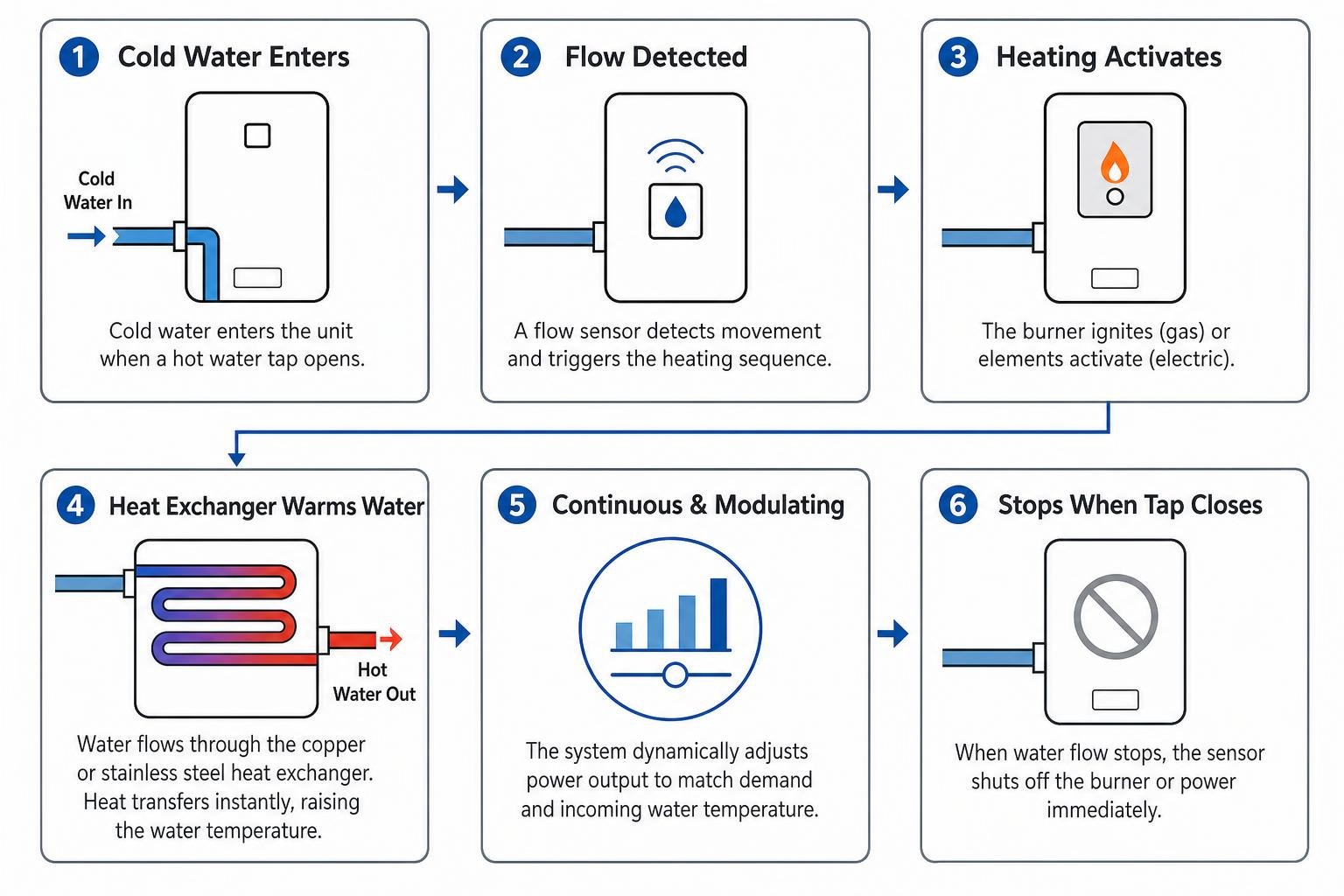
A continuous flow system operates on a purely on-demand principle. Cold water enters the unit through an inlet pipe when you open a hot water valve anywhere in your home. A precise flow sensor detects this movement and instantly triggers the heating sequence. In a gas-fired model, the electronic ignition lights the burner, modulating the flame based on your incoming water temperature and desired output. In an electric unit, advanced solid-state switches activate heavy-duty heating elements.
As water travels through the internal copper or stainless steel heat exchanger, heat transfers into the water almost instantly. The system dynamically adjusts its power output as demand changes. When you close the tap, the sensor detects that flow has stopped, immediately shutting off the fuel or electrical power.
Here is a straightforward comparison of how these heating technologies stack up against each other:
| Feature | Gas Continuous Flow | Electric Continuous Flow | Traditional Storage Tank |
|---|---|---|---|
| Heating Mechanism | High-efficiency gas burner on demand | Modulated electric elements on demand | Constant heating of stored water volume |
| Standby Energy Loss | None | None | Continuous daily heat loss through tank walls |
| Hot Water Supply | Continuous within rated flow rate | Continuous within rated flow rate | Limited to tank volume before running cold |
| Physical Footprint | Compact, wall-mounted | Ultra-compact, wall-mounted | Large, floor-standing metal cylinder |
| Typical Lifespan | 20+ years with maintenance | 15 to 20 years | 8 to 12 years |
| Energy Efficiency | High (Energy ratings up to 5.8+ stars) | High (Up to 99% thermal efficiency) | Moderate to low due to standby cooling |
On-Demand Heating vs Storage Tank Standby Loss
The biggest design flaw of a traditional tank is standby thermal loss. As a tank sits in a cold basement during a chilly Northeast Ohio winter, the heat inside the tank constantly radiates into the surrounding room. To keep that water ready, the tank has to burn fuel all day and night. Tankless water heaters result in energy savings on the order of 20% over an electric tank simply by eliminating this standby cycle.
When a storage tank runs out of hot water, recovery can take anywhere from 30 minutes to over an hour. If someone takes a long bath, the next person in line gets an icy surprise. When dealing with an older tank, you might find yourself troubleshooting burner issues or learning how to relight and restore hot water fast when the pilot light fails. With an on-demand unit, you never face a depleted tank because water is heated in real time.
Sizing Your Continuous Water Heater for Peak Demand
Choosing the right unit requires matching two critical numbers: peak flow rate and temperature rise. Flow rate is measured in gallons per minute (GPM) or liters per minute (L/min). Temperature rise represents the difference between the incoming groundwater temperature and your target output temperature.
In our northern climate, winter groundwater temperatures can drop below 45 degrees Fahrenheit. Raising that water to a comfortable 120 degrees requires a substantial 75-degree temperature rise.
When sizing a system, we calculate your simultaneous fixture usage:
- Standard showerhead: 1.5 to 2.5 GPM
- Kitchen sink faucet: 1.0 to 1.5 GPM
- Washing machine: 1.5 to 2.0 GPM
- Dishwasher: 1.0 to 1.5 GPM
If you want to run two showers and a dishwasher at the same time, your unit must be able to deliver around 5.5 to 6.5 GPM at the required winter temperature rise. Residential gas units like the Rheem Ultra 28L can deliver 28 liters per minute of continuous hot water delivery at a 25-degree Celsius rise, making them capable of handling multiple bathrooms at once. Commercial applications often require specialized high-capacity equipment. For instance, the Stiebel Eltron CF Plus commercial series provides high-output three-phase heating designed to hold precise temperatures across demanding industrial or circulation loads.
Minimum activation flow is another crucial technical detail. Units rely on a flow switch to turn on the burners. For example, some high-capacity electric units require a minimum flow rate of 0.7 GPM to fire up, while specialized low-flow units can detect flows as small as 1.6 L/min. Sizing ensures your faucets trigger the heating elements without short-cycling.
Primary Types and Energy Source Configurations
Continuous water heating systems come in several power configurations, each suited to different home layouts, fuel access, and commercial demands.
Gas-Fired vs Electric Tankless Configurations
Gas-fired tankless heaters use natural gas or liquid propane (LP) to generate intense, rapid heat. Because gas units produce exhaust gases, they require dedicated venting, typically double-wall stainless steel or specialized PVC/polypropylene direct-vent pipes that exit through a sidewall or roof. They also demand adequate gas supply lines, often requiring an upgrade from a standard 1/2-inch gas line to a 3/4-inch line to support the higher BTU firing rates required during peak flow.
Electric tankless heaters do not require venting or gas lines, making them flexible for tight spaces. However, their electrical demand is significant. A whole-house electric unit can draw anywhere from 80 to 150 amps or more, requiring multiple 40-amp double-pole circuit breakers and a 200-amp main electrical service panel. For commercial facilities, three-phase power allows for massive heating capacity across power ranges from 24 kW up to 144 kW.
Whether you are upgrading an older gas setup or retrofitting an electric layout, proper installation by licensed professionals is critical. Homeowners planning an upgrade can review our local Strongsville water heater services or connect with our team for water heater services in Brecksville to verify gas line capacity, electrical panel loads, and venting paths.
Direct Flow vs Indirect Buffer and Circulation Systems
In a direct flow setup, domestic cold water passes straight through the heat exchanger to your fixtures. This is the standard configuration for most single-family homes.
In larger properties, commercial facilities, or homes with extensive plumbing runs, indirect setups and dedicated recirculation loops are used. A recirculation line keeps hot water moving through the supply pipes, eliminating the delay between turning on the tap and feeling hot water.
Advanced engineering systems, such as the KTS water heater (S) PRO, utilize plate heat exchangers with capacities reaching up to 146 kW and abstraction rates up to 42 L/min. These units employ advanced digital controls, Modbus-RTU interfaces, and tilted plate configurations that reduce lime scale formation while maintaining strict temperature hygiene for domestic drinking water.
Some commercial electric units feature electronic hot-start technology. This maintains an internal heating core at a ready temperature without relying on a bulky tank, preventing the cold-water sandwich effect, a brief burst of unheated water that can occur during short stop-and-start cycles.
Key Technical Specifications, Safety, and Installation Requirements
A smooth installation requires careful evaluation of your home infrastructure. Here are the core technical items our technicians review on every job:
- Gas Supply Line Sizing: Ensuring line pressure remains stable when high-demand appliances run simultaneously.
- Venting Clearances: Maintaining safe distances from operable windows, doors, and mechanical air intakes.
- Electrical Capacity: Checking breaker space, wire gauge, and grounding connections for electric heating elements.
- Water Pressure and Flow: Confirming static water pressure stays within the 30 to 80 PSI range (or above 140 kPa for optimal performance).
- Enclosure Type: Selecting standard indoor enclosures or specialized NEMA 4/4X weatherproof enclosures for damp or harsh environments.
For residents in surrounding communities, our Richfield water heater services provide full site assessments to verify that your gas, water, and electrical infrastructure meet manufacturer standards and local building codes.
Essential Safety Features and Temperature Controls
Continuous water heaters incorporate multiple layers of digital and mechanical safety controls:
- Scald Prevention & Temperature Lockouts: Many residential models come factory-preset to 120 degrees Fahrenheit (50 degrees Celsius) to protect children and elderly family members from accidental scalding. Unlocked commercial units can reach up to 180 degrees Fahrenheit (approximately 75 to 80 degrees Celsius) for sanitation or industrial uses.
- Digital and Remote Controllers: Wall-mounted digital controllers allow users to adjust settings with precision. Commercial units like the CF Plus line offer accuracy within ±1.5 degrees Fahrenheit even at low flow rates.
- Overheat Protection (Flamesafe): Advanced gas systems include proprietary sensor wraps around the heat exchanger. If the metal shell exceeds safe operating temperatures, the system immediately cuts gas flow before damage occurs.
- Dry-Fire and Pressure Protection: Built-in water level sensors prevent electric elements from firing without water inside the chamber, while an external pressure relief valve guards against hydraulic pressure spikes.
Maintaining Your Continuous Water Heater for Long-Term Performance
While tankless units are durable, their high thermal transfer rates make them sensitive to water chemistry. Hard water contains dissolved calcium and magnesium. When heated rapidly, these minerals precipitate out of solution and coat the inside of the heat exchanger, creating an insulating scale barrier.
Over time, mineral scale restricts water flow, reduces efficiency, and causes hot spots that can crack the heat exchanger. To keep your unit running smoothly and protect your warranty coverage, follow these basic water quality benchmarks:
- Total Dissolved Solids (TDS): Less than 600 mg/L
- Total Hardness: Less than 200 mg/L (approx. 12 grains per gallon)
- pH Level: Between 6.5 and 8.5
- Chlorides: Less than 300 mg/L
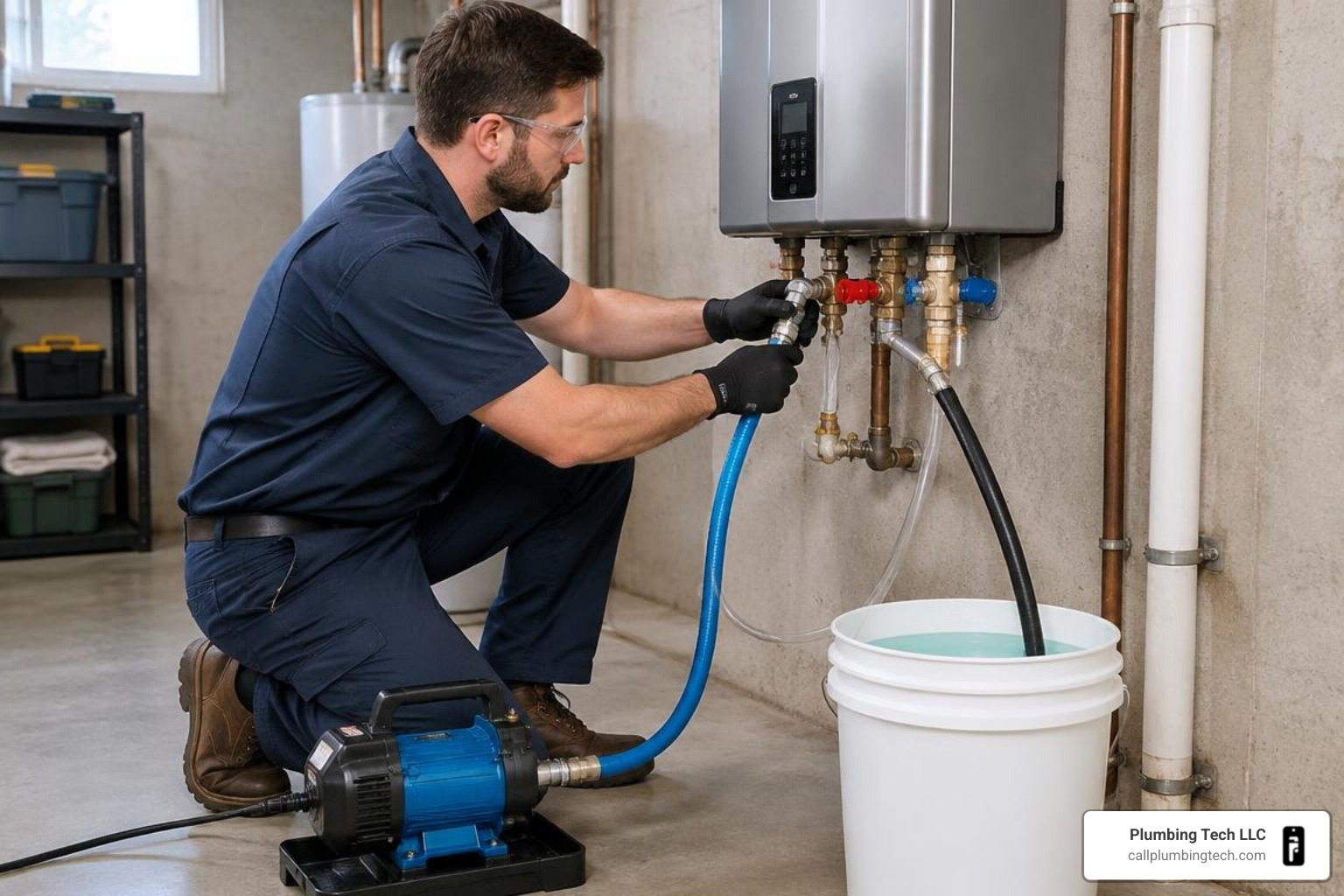
Routine maintenance involves an annual descaling flush using a mild food-grade acid or virgin white vinegar pumped through the isolation valves. This dissolves mineral deposits and restores peak heat transfer.
Leading manufacturers back their components with strong warranties when properly maintained. For example, the Rheem Ultra 28L features a 15-year warranty on the heat exchanger alongside 3 years of labor coverage, while high-efficiency systems from Dux offer a 12-year heat exchanger warranty with 3 years of full parts and labor.
Frequently Asked Questions About Continuous Flow Systems
How much energy does an on-demand unit save over a storage tank?
An on-demand system cuts energy usage by eliminating standby losses. Because it only consumes gas or electricity when a faucet is open, homeowners typically see energy savings of about 20% compared to a standard electric storage tank.
What minimum water flow rate is needed to activate the heating burner?
Activation thresholds depend on the model and sensor design. Most residential gas units require a flow of 0.5 to 0.75 gallons per minute (around 2 to 3 L/min) to engage the burner, while precision commercial units can activate at rates as low as 1.6 L/min or 0.7 GPM.
How does hard water impact the lifespan of the internal heat exchanger?
Hard water accelerates mineral scale accumulation inside the narrow passages of the heat exchanger. If left untreated, scale reduces heating efficiency and can cause localized overheating that cracks the internal metal. An annual descaling flush or the installation of a whole-home water softener ensures the heat exchanger lasts its full 20-year lifespan.
Conclusion
Upgrading from an outdated storage tank to a continuous flow water heater brings modern comfort, lower energy bills, and peace of mind to your home or business. With the ability to deliver endless hot water on demand, compact wall-mounted profiles that reclaim valuable floor space, and operational lifespans reaching beyond two decades, on-demand heating is the clear choice for modern plumbing systems.
At Plumbing Tech LLC, we bring over 25 years of combined plumbing experience to homeowners and commercial property managers throughout Greater Cleveland. As a veteran-owned business and certified backflow specialist, we stand behind our workmanship with modern diagnostic technology, 24/7 emergency response, and a 100% satisfaction guarantee.
Whether you need a comprehensive site evaluation, routine maintenance, or a clean system replacement, explore our full range of water heater repair and installation services to find the ideal setup for your property today.