Evaluating Configurations for Bathroom Fixtures
Choosing the right mounting setup is the first physical hurdle when updating a bathroom. Every sink basin or vanity countertop comes pre-drilled with a specific hole pattern. Attempting to install a fixture meant for one layout onto another without the proper conversion plates leads to alignment headaches or exposed drill holes.
The three primary configurations found in residential homes are single-hole, centerset, and widespread decks. Understanding how these formats interact with countertop space, cleaning routines, and plumbing rough-ins will help you avoid costly installation mistakes.
| Faucet Configuration | Hole Count | Hole Spacing | Best Sink Compatibility | Maintenance Profile |
|---|---|---|---|---|
| Single-Hole | 1 (or 3 with plate) | N/A | Vessel sinks, compact vanities, modern basins | Easiest to wipe down with minimal deck clutter |
| Centerset | 3 | 4 inches | Standard drop-in and pedestal sinks | Tight spacing between handles makes deck cleaning slightly harder |
| Widespread | 3 | 6 to 16 inches | Large master vanities, undermount double sinks | Open spacing makes cleaning around individual parts very easy |
Single-Hole vs. Centerset Bathroom Fixtures
Single-hole fixtures feature a unified spout and control mechanism integrated into a single column. They take up minimal space on the countertop, making them the standard choice for modern minimalist designs, vessel sinks, and compact powder rooms. Many single-hole models include an optional deck plate, often called an escutcheon, which allows you to install them on standard 3-hole sinks by covering the unused outer holes.
Centerset setups combine the spout and dual handles onto a single, solid 4-inch baseplate. They are engineered specifically for 3-hole sinks where the distance between the hot and cold water inlets measures exactly four inches from center to center. Centerset units are common in budget-friendly renovations and rental properties because the rigid base guarantees alignment right out of the box. However, because the spout and handles sit close together on an integrated deck, dirt and mineral deposits often collect around the baseplate edges, requiring careful scrubbing.
Widespread Layouts and Architectural Bathroom Fixtures
Widespread configurations offer the greatest visual versatility and design impact for large vanity spaces. Instead of using a shared baseplate, widespread designs use three completely independent pieces: a dedicated central spout, a hot water valve, and a cold water valve. The standard spacing between the outer handles ranges from 6 to 16 inches, with 8 inches serving as the residential standard.
Because widespread units do not rely on a fixed metal bridge above the counter, they can accommodate custom hole drillings on natural stone countertops. Premium models like the KOHLER Purist Widespread Faucet showcase clean architectural lines, solid brass components, and low-arc profiles that elevate a master suite remodel. The open space between parts makes wiping down the countertop straightforward, though the installation beneath the counter requires a multi-port water connection.
Single-Handle vs. Two-Handle Faucet Designs
Beyond the physical hole spacing, deciding between a single-handle and a two-handle control directly impacts how you interact with your sink every day. Homeowners often weigh the classic symmetry of two handles against the quick convenience of a single lever. If you need help choosing the best layout for your layout, our team provides expert plumbing fixture upgrades to help you find the right fit.
Handle Mechanics and Daily Usability
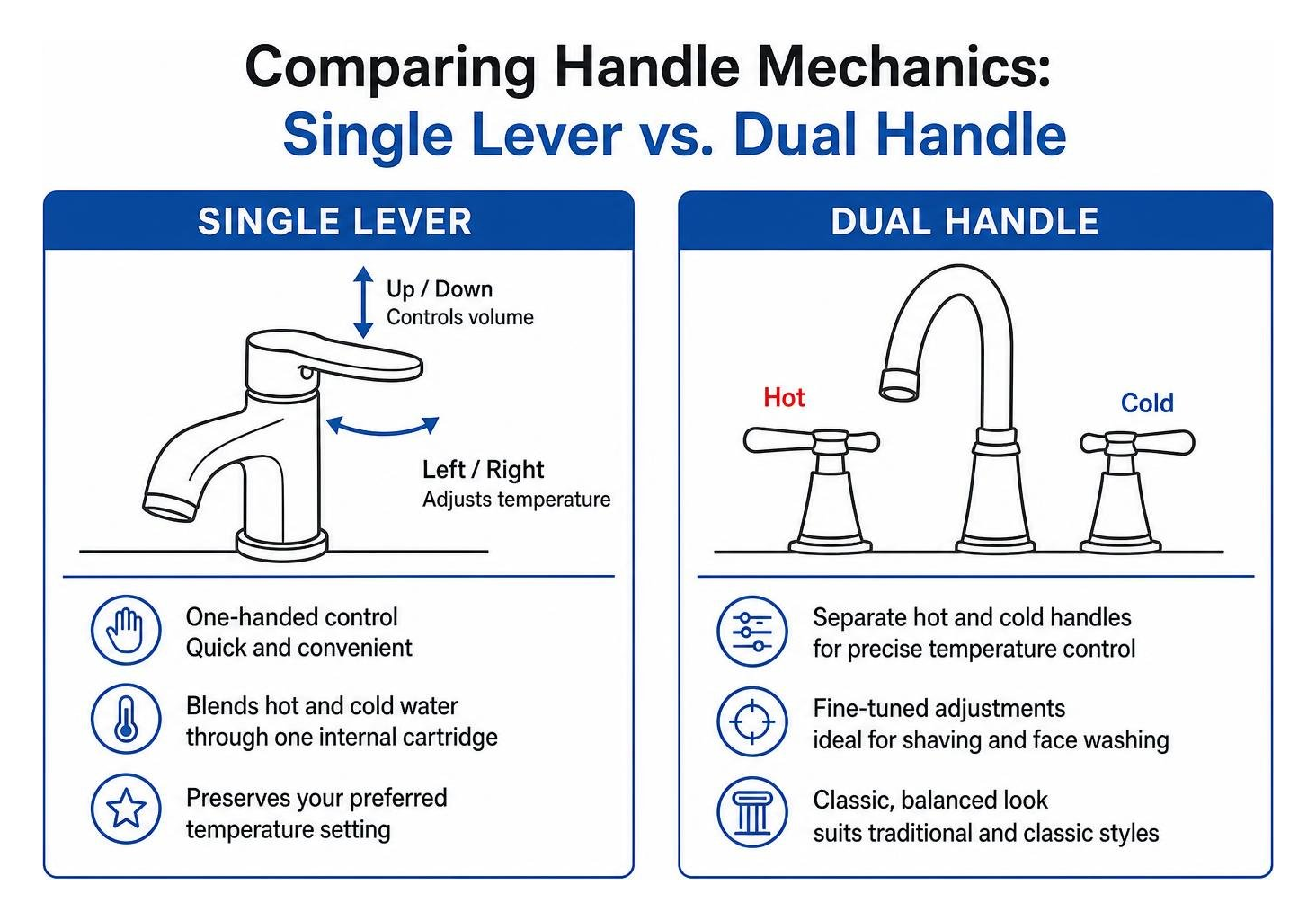
Single-handle faucets blend both hot and cold water through a single internal cartridge. Moving the lever up controls the volume, while pivoting it left or right adjusts the temperature. This one-handed control is practical for busy mornings, washing messy hands, or assisting young children. It also preserves your temperature preference if you leave the lever angled to your favorite spot before shutting it off.
Two-handle faucets dedicate one handle to cold water and one to hot. This mechanical separation allows for fine-tuned temperature adjustments, which many homeowners appreciate for shaving or washing their face. The dual-handle aesthetic provides a traditional, balanced look that complements farmhouse, classic, or historic bathroom styles.
Installation Complexity and Maintenance Demands
The mechanical difference between these styles also changes how they are serviced over time:
- Under-Sink Connections: Single-handle models connect directly to the hot and cold shut-off valves using two flexible supply lines. Two-handle widespread models require a quick-connect hose assembly or tee-fitting to join the separate valve bodies to the central spout.
- Leak Points: A single-handle faucet contains one internal valve cartridge to inspect and replace. Two-handle setups contain two separate stem cartridges or washerless valves, doubling the internal seals that may wear down over decades of use.
- Mechanical Adjustments: Two-handle faucets require proper valve orientation during installation. If the internal stops or glide rings are misaligned, the handles may not sit straight in the off position, requiring disassembly to reset the splines.
Comparing Faucet Finishes, Materials, and Performance Technologies
The exterior finish and internal valve engineering determine how well a fixture handles daily use, hard water exposure, and moisture over its lifespan.
Finish Durability: Chrome, Brushed Nickel, Stainless, and Bronze
Selecting a finish involves balancing bathroom aesthetics with everyday cleaning requirements:
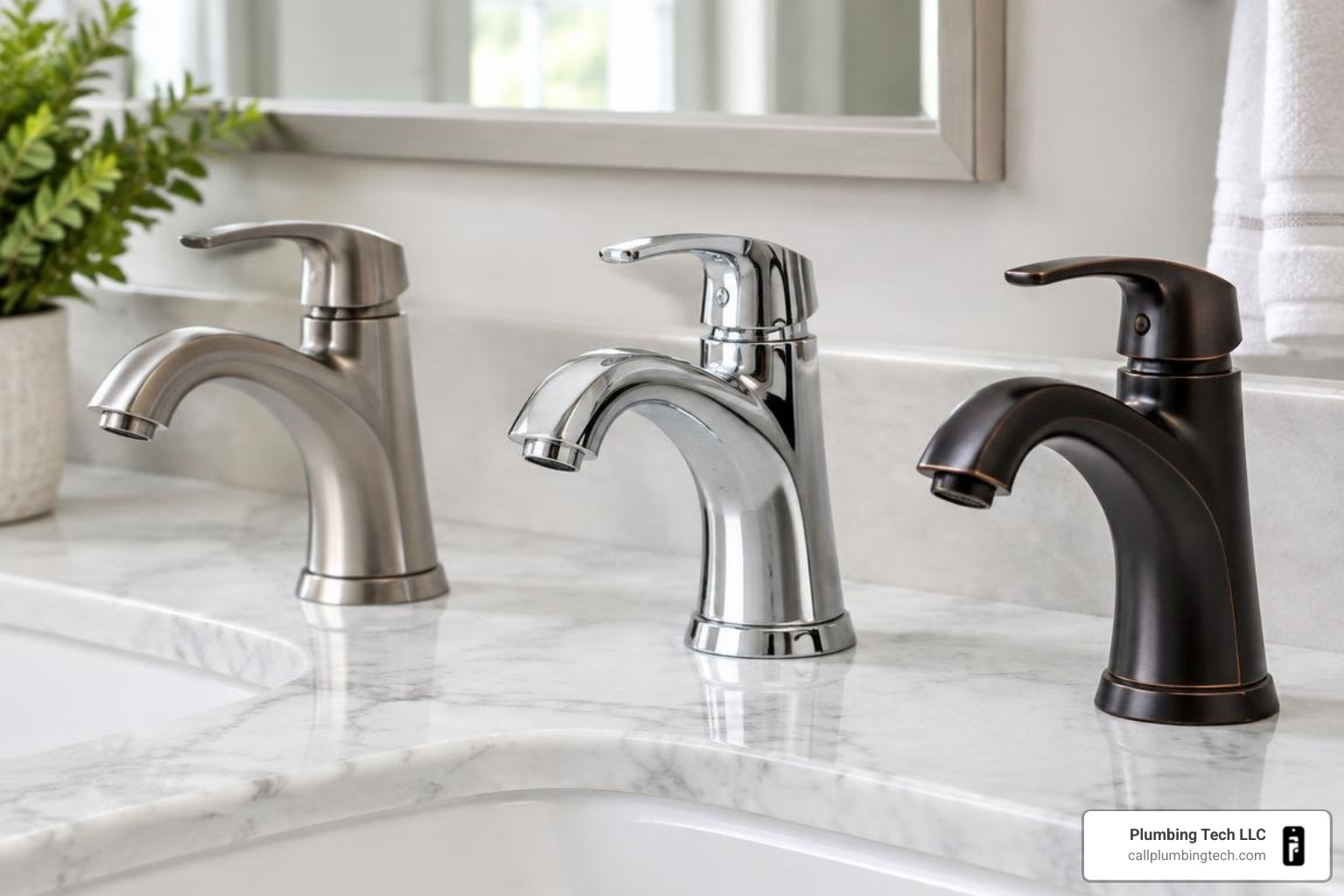
- Polished Chrome: Chrome remains a popular, cost-effective finish. Modern chrome treatments are tested to exceed standard corrosion benchmarks by a factor of two. Its reflective surface brightens darker bathrooms, but it readily shows water spots, fingerprints, and soap residue, requiring frequent wiping with a microfiber cloth.
- Brushed Nickel & Stainless Steel: Brushed textures scatter light, naturally hiding minor smudges and light mineral deposits. Delta’s Brilliance Stainless finish relies on Physical Vapor Deposition (PVD), a process that bonds the finish to the metal at an atomic level to resist abrasions, tarnishing, and corrosion from harsh household cleaners.
- Champagne Bronze & Matte Tones: Warm metallic tones like champagne bronze deliver a custom, high-end look. However, darker or warm satin finishes require regular drying after use to prevent white calcium rings around the base of the spout and handles.
Advanced Engineering: Diamond Seal, Lumicoat, and PEX Lines
Internal engineering has advanced beyond basic rubber washers and standard brass stems. Modern premium faucets incorporate proprietary technologies designed to extend product life and reduce maintenance.
A prime example is Delta’s Diamond Seal Technology, which utilizes a ceramic disc coated in industrial diamonds. This design eliminates traditional rubber seals, reduces internal wear, and is tested to last for 500,000 cycles, lasting twice as long as standard industry benchmarks.
Exterior coatings have also seen notable improvements. For instance, the Delta Trillian Single Handle Faucet features a Lumicoat finish, an ultra-hydrophobic barrier that repels liquids and resists mineral buildup, allowing you to wipe away hard water stains without chemical cleaners. Many modern fixtures also come with integrated InnoFlex PEX supply lines pre-installed inside the faucet body, eliminating cross-joint leaks beneath the sink deck.
WaterSense Efficiency, Accessibility Standards, and Drain Systems
Selecting high-performing hardware also involves reviewing environmental standards, accessibility guidelines, and mechanical drain assemblies. Homeowners looking to lower utility bills or improve mobility can rely on our professional fixture installation to ensure all components meet current local building codes.
Water Conservation and Flow Rate Standards
The Environmental Protection Agency (EPA) manages the WaterSense program to help households conserve water without sacrificing performance. Standard, older bathroom faucets often flow at 2.2 gallons per minute (GPM). WaterSense-labeled fixtures use a maximum of 1.2 to 1.5 GPM at 60 psi, saving 20% or more water compared to traditional designs.
These savings reduce both your monthly municipal water bill and the natural gas or electricity required to heat the water. High-efficiency faucets achieve this savings by using engineered aerators and stream straighteners, which mix air into the water column to produce a solid, satisfying stream that prevents splashing.
ADA-Compliant Lever Handles and Universal Design
The Americans with Disabilities Act (ADA) establishes guidelines for fixture usability, which have become a core element of modern universal residential design. To meet ADA standards:
- Operating mechanisms must be operable with one hand.
- Controls must not require tight grasping, pinching, or twisting of the wrist.
- The operating force required to activate the water must not exceed 5 pounds of force.
Lever handles, single-lever paddles, and motion-activated faucets meet these standards, making them practical for family members with arthritis or reduced grip strength.
Pop-Up Drains vs. Lift Rod Drain Assemblies
When replacing a faucet, the matching drain assembly plays an important role in installation simplicity and routine cleaning:
- Push-Pop Drains (Clicker Style): These drains operate with an internal spring mechanism. You press down on the metal stopper to seal the basin and press it again to release it. Because they do not require mechanical linkages behind the faucet spout, they are easy to install, clean, and fit into tight vanity cabinets.
- Lift Rod Assemblies: Traditional setups use a metal rod that extends through the back of the spout body, connecting beneath the sink via a pivot rod, clevis strap, and spring clip. While classic in design, lift rods require precise manual adjustment to create a tight seal. Over time, hair and soap scum can snag on the horizontal pivot ball inside the pipe, requiring periodic disassembly to clear blockages.
Installation Pitfalls, Pricing Tiers, and Troubleshooting Common Problems
Even high-end fixtures can run into performance problems if installation tolerances are overlooked. When planning your project, having the right supplies ready ensures a smooth, leak-free installation. Homeowners in Northeast Ohio can take advantage of our bathroom fixture installation and repair services for reliable, same-day service.
Essential Supplies Checklist for Faucet Installation
- Adjustable wrench and basin wrench
- Thread seal tape (PTFE)
- Plumber’s putty or silicone sealant (check sink material compatibility)
- Safety glasses and collection bucket
- Strap wrench (to protect decorative finishes from scratches)
- Replacement 3/8-inch compression supply lines (if not integrated into the faucet)
Deck Thickness, Supply Connections, and Splash Prevention
Countertop dimensions and water lines introduce three common points of friction during an install:
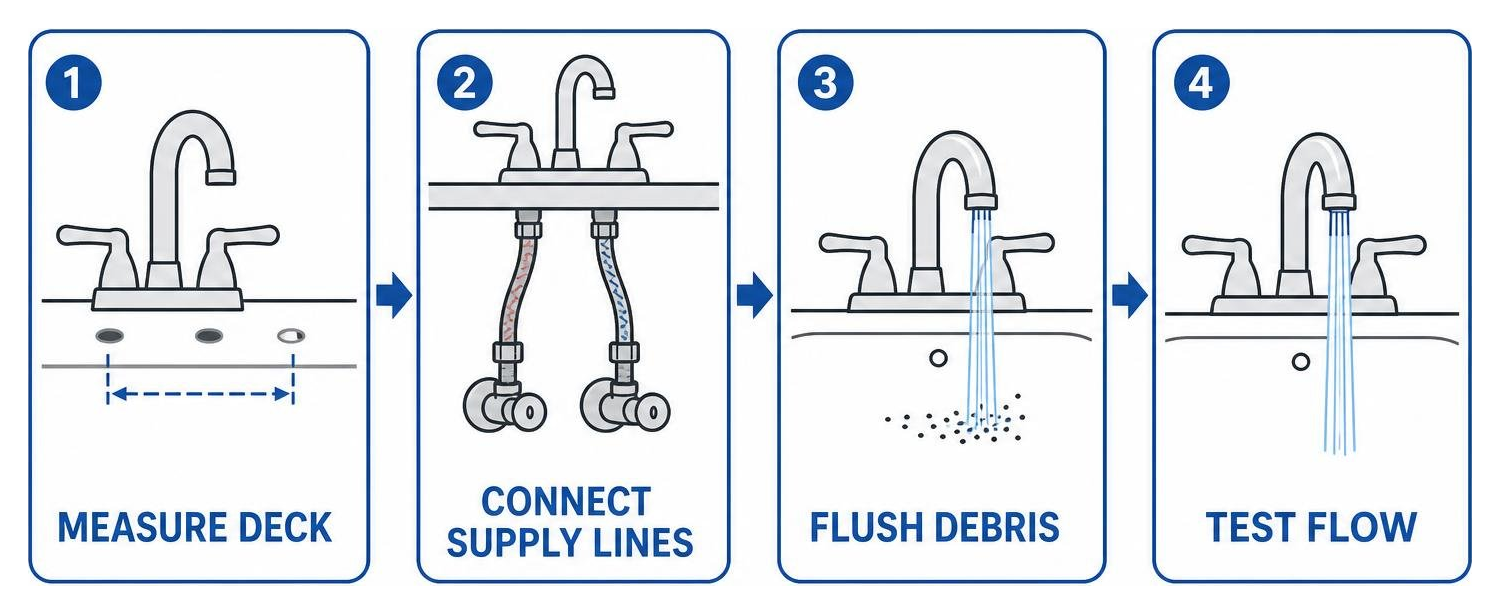
- Countertop Thickness: Standard bathroom fixtures are engineered for sink decks up to 1-1/8 inches thick. If you are installing a faucet on a thick slab of granite, quartz, or a custom concrete vanity, standard mounting shanks will not have enough thread clearance to secure the lock nuts. You will need to purchase an extended mounting kit to bridge decks up to 2-1/4 inches thick.
- Supply Line Flushing: Before connecting a new faucet cartridge to the water mains, always place your flexible supply lines into a bucket and turn on the shut-off valves for 15 seconds. Plumbing work shakes loose copper shavings, solder flux, and mineral scale inside the pipes. Flushing the lines prevents debris from jamming the delicate ceramic disc seals or clogging the aerator.
- Basin Splashing: Splashing usually happens when a high-arc spout drops water straight into a shallow basin, or when household water pressure exceeds 60 psi. You can fix this by throttling down the under-sink angle stops, installing a lower-flow aerator insert, or selecting a faucet with an angled stream straightener that directs the flow toward the back slope of the sink.
Budget Breakdown Across Entry-Level and Luxury Models
Bathroom faucets fall into distinct construction tiers that balance budget constraints with material longevity:
- Entry-Level Models: These fixtures generally use plastic internal pathways, lightweight zinc-alloy shells, and standard washerless cartridges. They work well for quick updates or low-traffic powder rooms, but they usually require cartridge replacements after a few years of heavy use.
- Mid-Range Options: Mid-tier models introduce solid brass mounting shanks, durable PVD metal finishes, and WaterSense-certified ceramic disc valves. They provide dependable, leak-free performance for family bathrooms and come backed by comprehensive lifetime limited warranties.
- Luxury & Architectural Collections: High-end fixtures feature solid forged brass construction, high-grade ceramic discs, custom designer finishes, and advanced liquid-repellent coatings. They deliver a substantial physical weight, precise handle movement, and durable performance designed to last for decades.
Frequently Asked Questions About Bathroom Sinks and Faucets
How do I fix low water flow in a newly installed bathroom faucet?
Low water flow in a brand-new installation is almost always caused by construction debris clogging the aerator or the internal cartridge inlets. Start by turning off the under-sink shut-off valves and unscrewing the aerator or stream straightener from the spout tip using needle-nose pliers or the manufacturer’s removal tool. Rinse out any caught sand, rust flakes, or sediment.
If the aerator is clear, remove the handle set-screw, lift off the handle cap, and unscrew the bonnet nut to inspect the ceramic cartridge. Soak the cartridge in a 50/50 mix of warm water and white vinegar for 15 minutes to break down hard mineral deposits, flush your supply lines into a bucket, and reassemble the unit. Never remove the internal flow restrictor permanently, as this can cause splashing and violate local efficiency standards.
Which faucet finish requires the least maintenance against hard water spots?
Brushed nickel, PVD stainless steel, and fixtures with hydrophobic barrier coatings require the least daily maintenance. The directional brushing on nickel and stainless finishes scatters light reflections, naturally hiding water rings, hand smudges, and light lime deposits.
Fixtures protected by specialized surface coatings make water bead up and roll off the spout before minerals can dry onto the metal. Highly reflective polished chrome and dark matte finishes show mineral rings more quickly, requiring daily wipe-downs with a soft microfiber cloth to keep their showroom shine.
Can I install a single-hole faucet on a three-hole vanity top?
Yes, you can install a single-hole faucet onto a 3-hole sink deck by using a compatible baseplate, also known as an escutcheon. Many single-handle bathroom faucets include an optional 4-inch wide baseplate in the box specifically for this purpose.
The plate sits flat against the countertop surface, using an underlying rubber gasket or a thin bead of plumber’s putty to seal the outer mounting holes against water leaks while securing the single-hole faucet through the center opening.
Conclusion
Upgrading your bathroom hardware is a fast, impactful way to refresh your home’s look and improve water efficiency. By checking your sink’s hole spacing, choosing a durable finish, and selecting reliable internal ceramic valves, you can invest in a setup that will hold up to daily family routines for years to come.
Whenever you are ready to update your master en-suite or resolve stubborn leaks beneath the vanity, reach out to our team at Plumbing Tech LLC. As a veteran-owned business with over 25 years of combined experience across Greater Cleveland, we back our work with a 100% satisfaction guarantee. Contact us today to schedule your comprehensive bathroom fixtures service and let our licensed professionals handle the installation.