Why a Two-Way Sewer Cleanout Matters
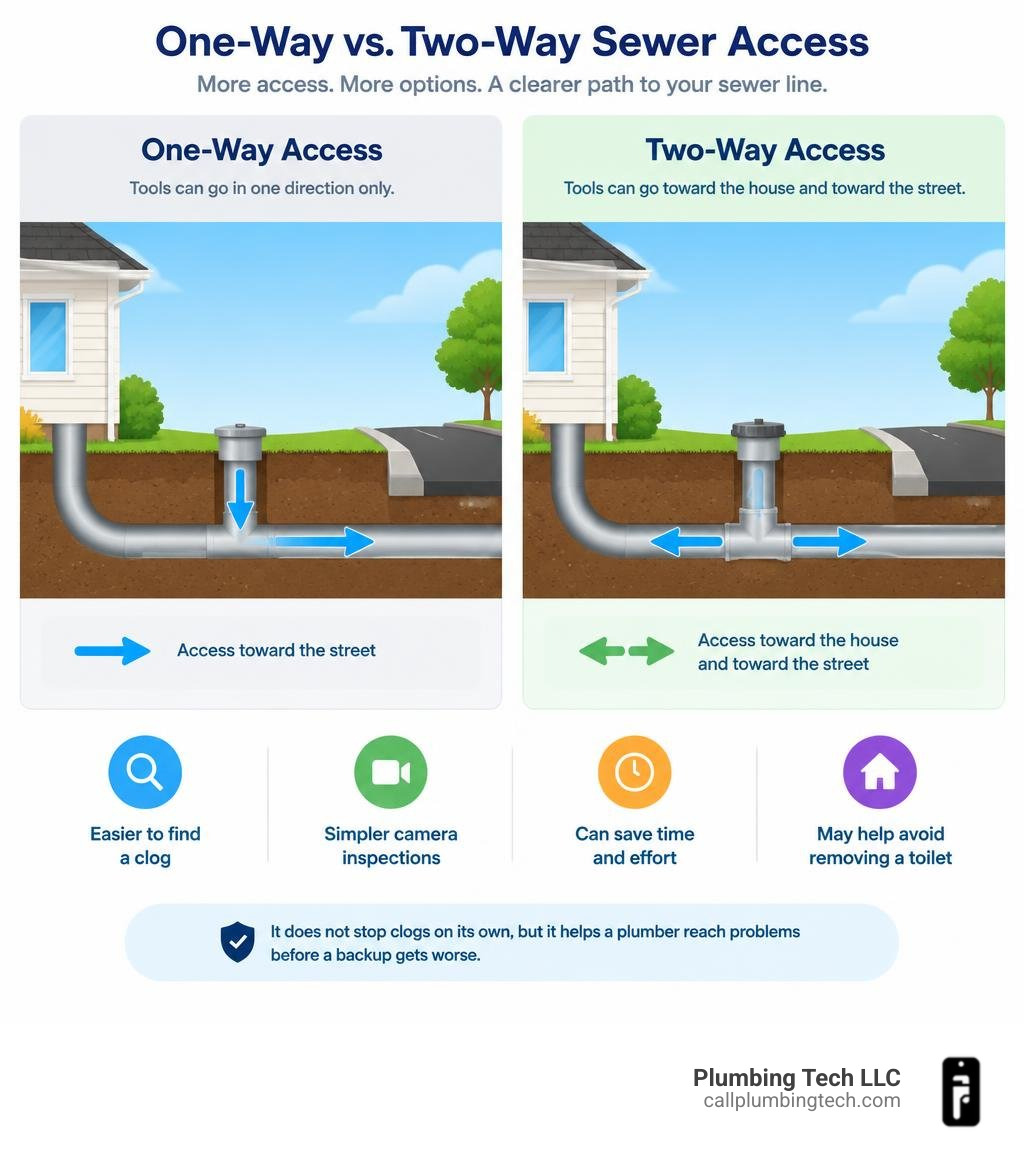
A two-way sewer cleanout gives a plumber access to your sewer line in both directions: toward the house and toward the street. A standard one-way cleanout guides tools in just one direction.
That extra access can make it easier to find a clog, inspect the pipe with a camera, and clean the line from outside. It may save time and avoid removing a toilet for access. It does not stop clogs on its own, but it helps a plumber reach problems before a backup gets worse.
Understanding the 2 Way Sewer Cleanout and How It Works
Every time you flush a toilet, run the washing machine, or drain a sink, gravity carries wastewater through your home’s interior piping and into the main building lateral. This lateral connects your private plumbing system to the municipal sewer main beneath the street. When everything flows freely, you never have to think twice about what happens underground. However, when solid waste, heavy grease, or invasive tree roots obstruct that passage, wastewater has nowhere to go but backward into your living space.
A 2 way sewer cleanout serves as the central control gateway for this entire underground network. Installed along the lateral pipe outside your foundation, this specialized assembly provides direct, bidirectional access to the subterranean line. Unlike basic drain caps that only let a technician work down toward the municipal main, a bidirectional setup allows equipment to travel seamlessly in either direction.
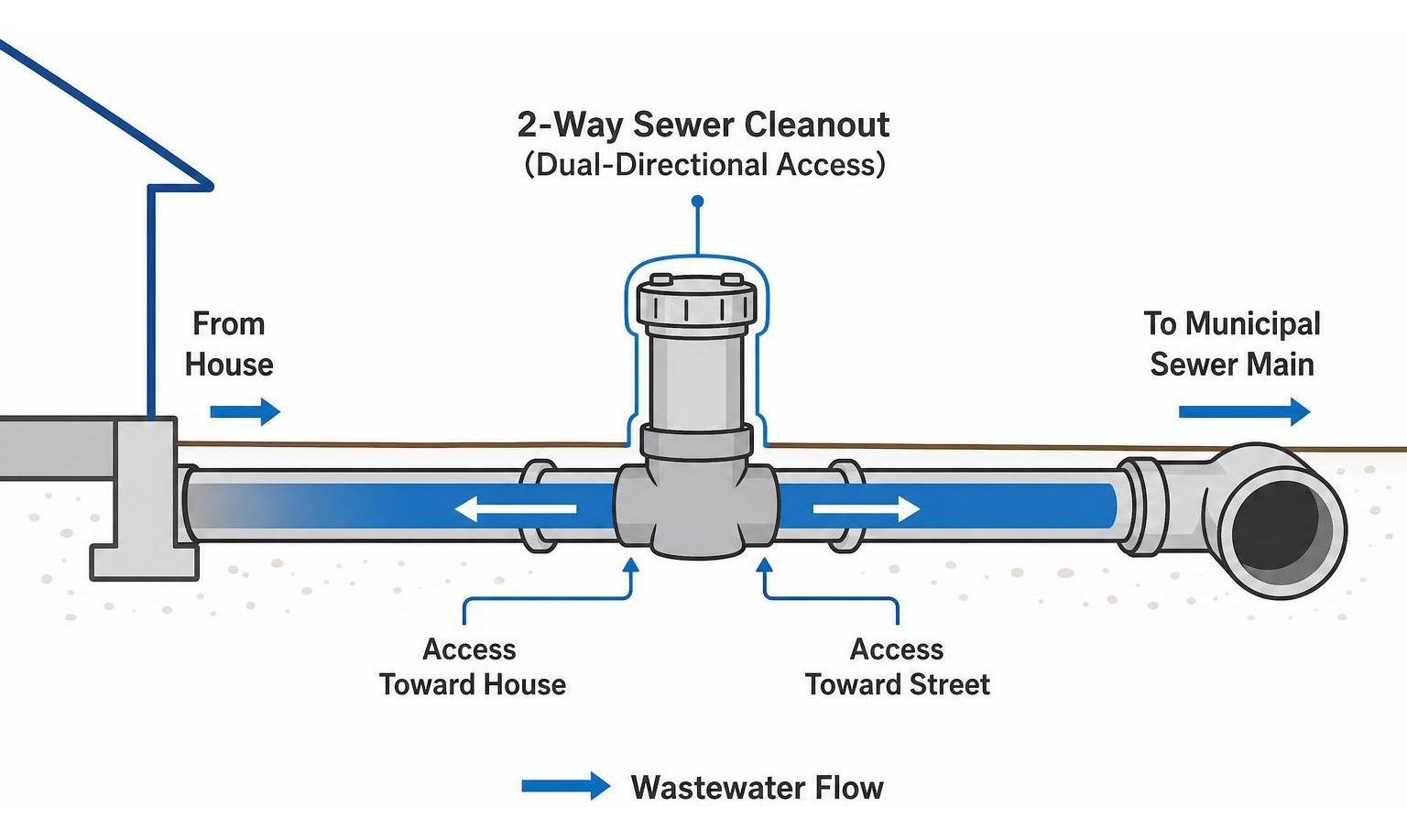
In non-pressurized, gravity-fed drain, waste, and vent (DWV) systems, wastewater must flow uninterrupted along a calculated downward slope. Introducing a dual-entry fitting into this run creates an engineered service hub. If an obstruction sits upstream underneath your living room slab, a technician inserts tools to run back toward the foundation. If the blockage sits fifty feet away near the street connection, the technician sends those same tools downstream toward the city main. When looking at municipal frameworks, such as standard two-way cleanout installation models, having clear access on both sides of the property line clarifies maintenance responsibilities between the property owner and the local utility.
Anatomy and Components of a 2 Way Sewer Cleanout
A bidirectional cleanout is a specialized plumbing assembly designed to handle heavy mechanical forces without catching debris.
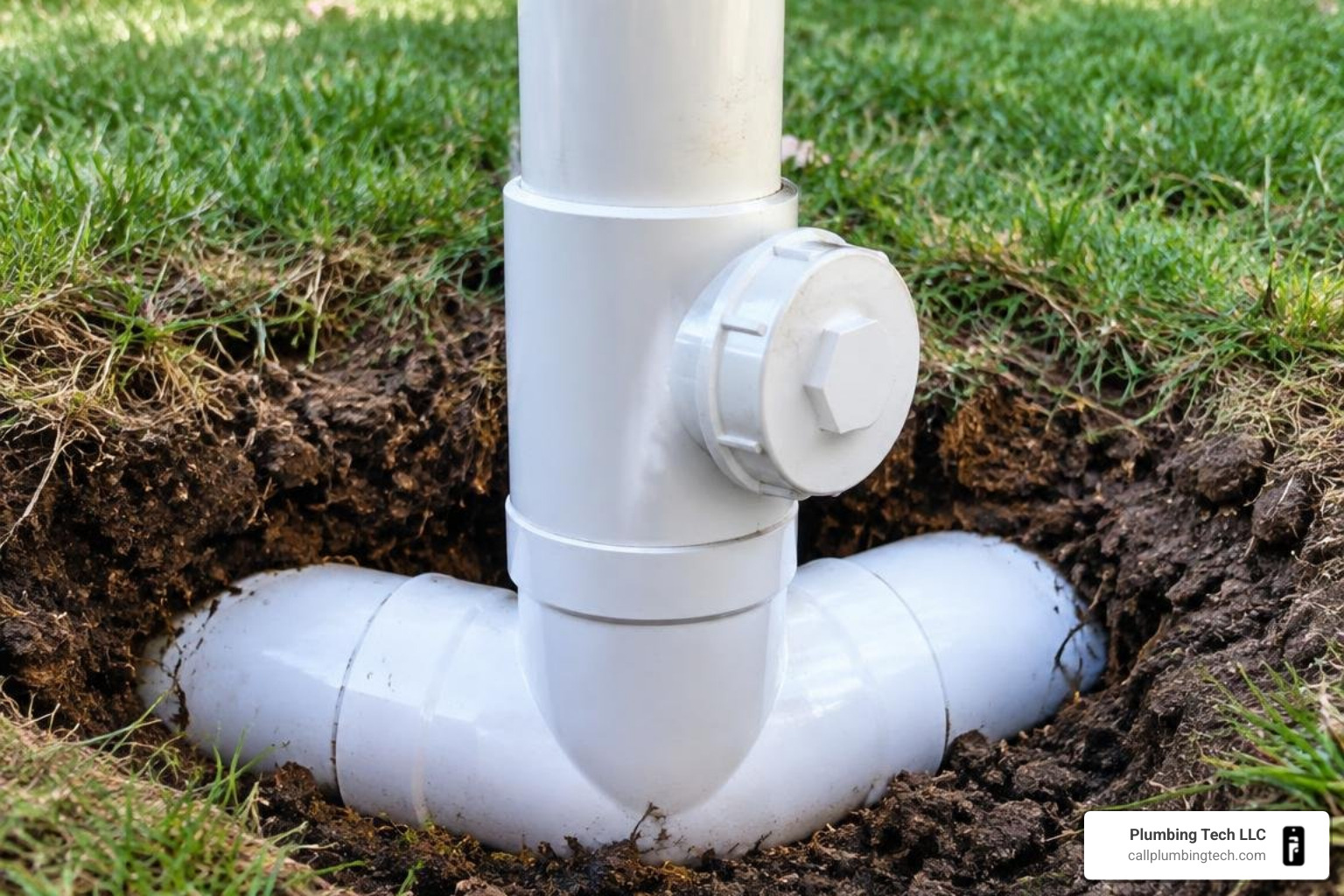
The core structure consists of several vital parts:
- The Double-Sweep Base Fitting: At the bottom of the installation sits the main body, engineered with smooth, curved internal channels. These sweeping interior curves direct flexible cables, high-pressure hoses, and diagnostic cameras smoothly in the technician’s chosen direction without snagging.
- The Vertical Riser Pipe: Extending upward from the base hub toward the ground level, a vertical pipe brings the access point to grade. This eliminates the need to dig up your lawn whenever the sewer line requires routine service.
- The Threaded Cleanout Plug: Securing the top of the riser is a heavy-duty, threaded PVC or brass plug. This plug maintains an airtight and watertight barrier, preventing dangerous sewer gases from venting into your yard and stopping surface water from flooding the drainage system.
- The Protective Ground Box: In driveways, walkways, or landscaped turf, a durable access housing surrounds the threaded cap to shield it from lawnmowers, foot traffic, and vehicle loads.
The internal geometry of this fitting is designed specifically for non-pressurized DWV applications. Technical documentation for a standard PVC DWV 2-way cleanout tee outlines how the dual-curved transitions guide motorized cables smoothly into the drainage stream.
Comparing Single-Direction Fittings to a 2 Way Sewer Cleanout
Standard single-direction fittings, such as single sanitary tees or standard wyes, force maintenance equipment in only one direction. If a one-way cleanout points toward the street, a plumber has no direct exterior path to service a clog located between that cleanout and the house. To resolve an upstream blockage, the plumber must bring heavy, motorized machinery inside the home or remove a toilet from its wax ring seal.
| Feature | Single-Direction Cleanout | 2-Way Cleanout Tee | Double Wye Cleanout Assembly |
|---|---|---|---|
| Directional Access | One direction only (downstream) | Bidirectional (house and street) | Bidirectional (house and street) |
| Indoor Access Needed | Frequently (for upstream clogs) | Never | Never |
| Excavation Footprint | Small | Compact single-trench | Wider trench required |
| Tool Insertion Smoothness | Moderate resistance | Smooth curved internal sweeps | Gradual 45-degree entries |
| Component Count | Single body and cap | Single integrated body and cap | Multiple fittings and two caps |
The table above demonstrates why modern installations favor bidirectional designs. Combining both access angles into a single location saves space in the yard while providing complete control over the entire sewer lateral.
Core Advantages of Dual-Direction Cleanouts for Property Owners
Investing in an exterior dual-direction cleanout pays dividends across the lifespan of your property. It transitions sewer line management from a stressful, reactive emergency into a predictable, manageable maintenance routine. When sewer lines become sluggish, our emergency plumbing services rely on these direct access ports to clear obstructions quickly and prevent property damage.
Preventing Catastrophic Indoor Backups and Water Damage
The most urgent reason to install a dual-access port is protecting your home’s finished interior. When a main sewer line clogs, wastewater continues to accumulate behind the obstruction. Because water seeks its own level, every drop sent down an upper-floor drain pushes blackwater out through the lowest fixtures in the building, such as basement floor drains, ground-level bathtubs, and toilets.
Raw sewage overflows bring severe health hazards, bacteria, and destructive moisture into your living space. Replacing contaminated hardwood flooring, tearing out saturated drywall, and running industrial dehumidifiers for structural drying can cost thousands of dollars. An exterior bidirectional cleanout provides a rapid pressure relief and diagnosis point. If a backup begins, a technician can quickly open the outside cap to relieve head pressure and address the clog before waste spills across your bathroom floor.
Keeping Heavy Machinery and Mess Outside the Home
Traditional drain clearing often requires bringing heavy, cumbersome drum machines through your front door, across carpets, and into cramped bathrooms. Maneuvering grease-coated sewer cables around interior doorways risks scraping walls, staining carpets, and spreading foul odors throughout the home.
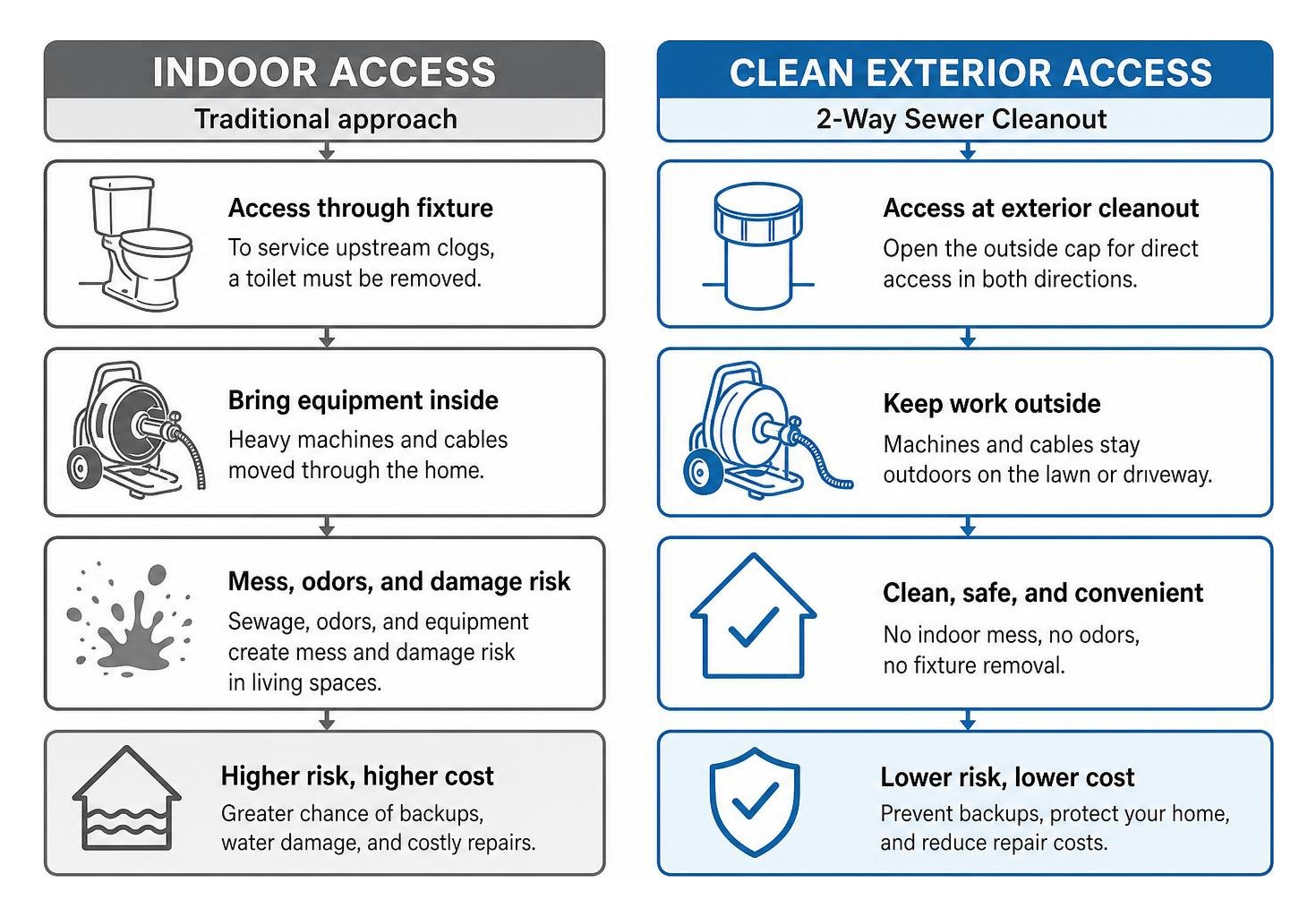
An exterior cleanout moves the entire work area outside onto the lawn or driveway:
- No Fixture Removal: Technicians do not need to pull toilets, scrape old wax rings, or unbolt fixtures.
- Clean Living Spaces: Heavy motors, drain snakes, and hydro jetting lines stay outdoors.
- Odor Containment: Sewer gases release into the open air instead of concentrating inside interior living areas.
- Quiet Operation: High-power drain equipment operates outside, minimizing indoor disruption.
Maximizing Cost Savings on Diagnostics and Labor
Labor hours make up a major portion of any plumbing service bill. When technicians must locate buried interior pipes, disassemble plumbing fixtures, or manually navigate tight indoor bends, labor costs add up quickly.
Having an easily accessible dual-direction port cuts service time considerably. Technicians set up their gear directly over the riser, deploy diagnostic cameras or cutting blades within minutes, and resolve the problem rapidly. This straightforward access lowers standard service times, simplifies routine maintenance, and helps you avoid emergency fees tied to complex fixture removals.
Enhancing Drain Cleaning, Hydro Jetting, and Video Inspections
Clearing a stubborn sewer blockage requires direct physical leverage and the right tools. Installing a bidirectional access port allows specialized drain machinery to operate at maximum efficiency, improving overall drain cleaning results.
High-Definition Sewer Camera Inspections
Visual diagnostics have changed modern plumbing by eliminating guesswork. Instead of digging up your yard to find a broken pipe, technicians feed a fiber-optic video camera into the line to inspect the interior walls in real time.
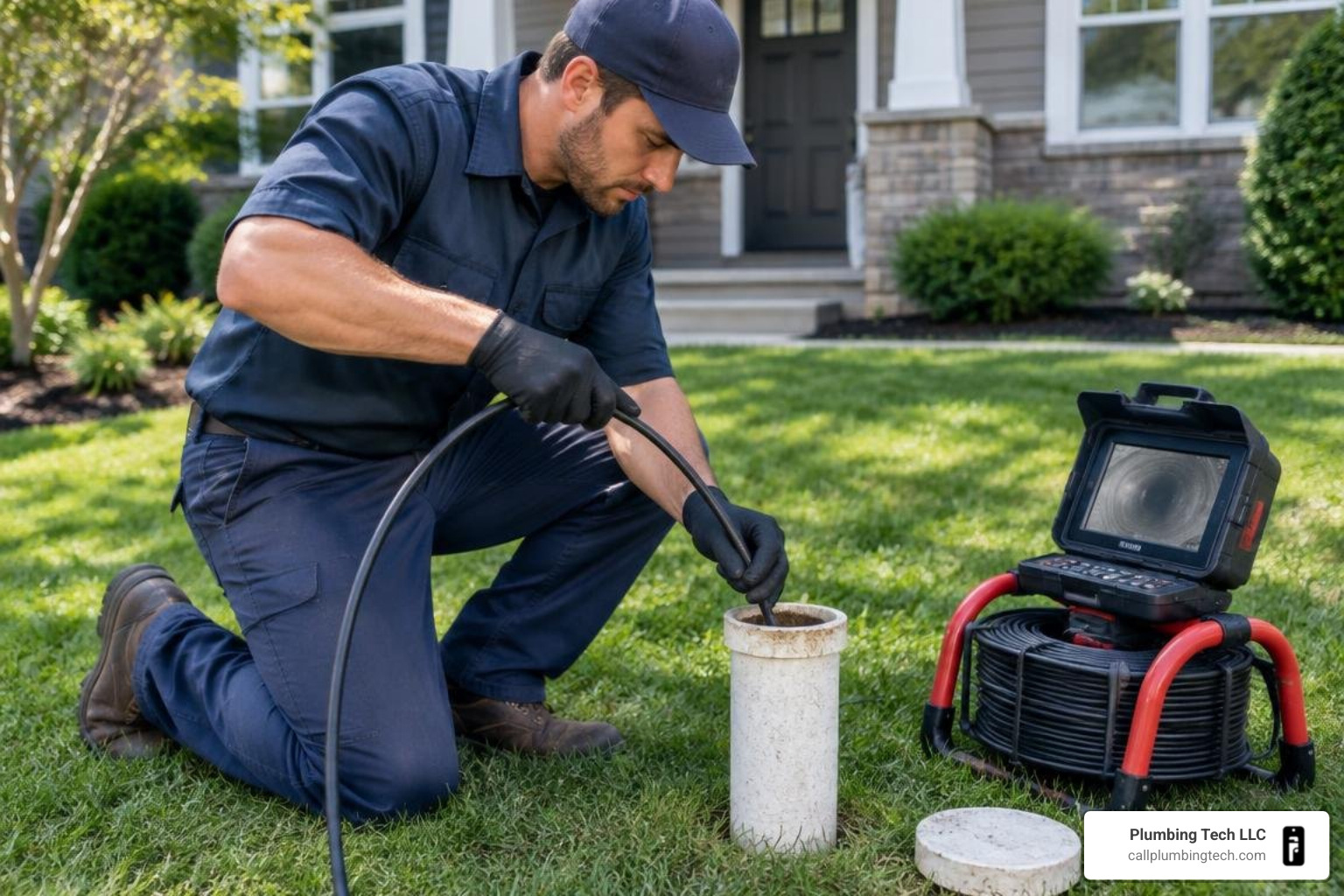
Using a bidirectional port, a technician performs a comprehensive sewer camera inspection in both directions from a single access point. The camera travels upstream under the foundation to check for unvented branch lines, scale buildup, and structural cracks beneath the concrete slab. Then, rotating into the downstream run, the camera travels toward the street to check for pipe settling, low spots that hold sludge, joint offsets, and invasive tree roots.
Full-Diameter Mechanical Snaking and Hydro Jetting
The size of the access point determines the size of the cleaning tool a plumber can use. When servicing a sewer line through an indoor cleanout or removed toilet drain, the technician is often limited to smaller 3-inch blades to navigate tight fixture traps and narrow internal bends.
Using a 3-inch blade inside a standard 4-inch main sewer lateral leaves a 1-inch ring of grease, sludge, and tree roots clinging to the pipe walls. This leftover debris catches flushed toilet paper, leading to another clog shortly down the road.
Exterior bidirectional cleanouts connect directly to the main line, allowing the use of full-diameter 4-inch cutting blades. Plumbers can run high-powered root cutters and industrial hydro jetting nozzles straight down the pipe. Hydro jetting uses high-pressure water streams to scrub away grease deposits, blast away invasive roots, and restore the pipe to its full diameter.
Material Selection, Installation Standards, and Plumbing Codes
Properly installing a bidirectional cleanout requires selecting durable materials and following strict plumbing codes. Quality installation ensures the fitting withstands ground movement, soil weight, and years of regular maintenance. If a structural failure occurs within the lateral run, a professional sewer repair can restore full drainage flow.
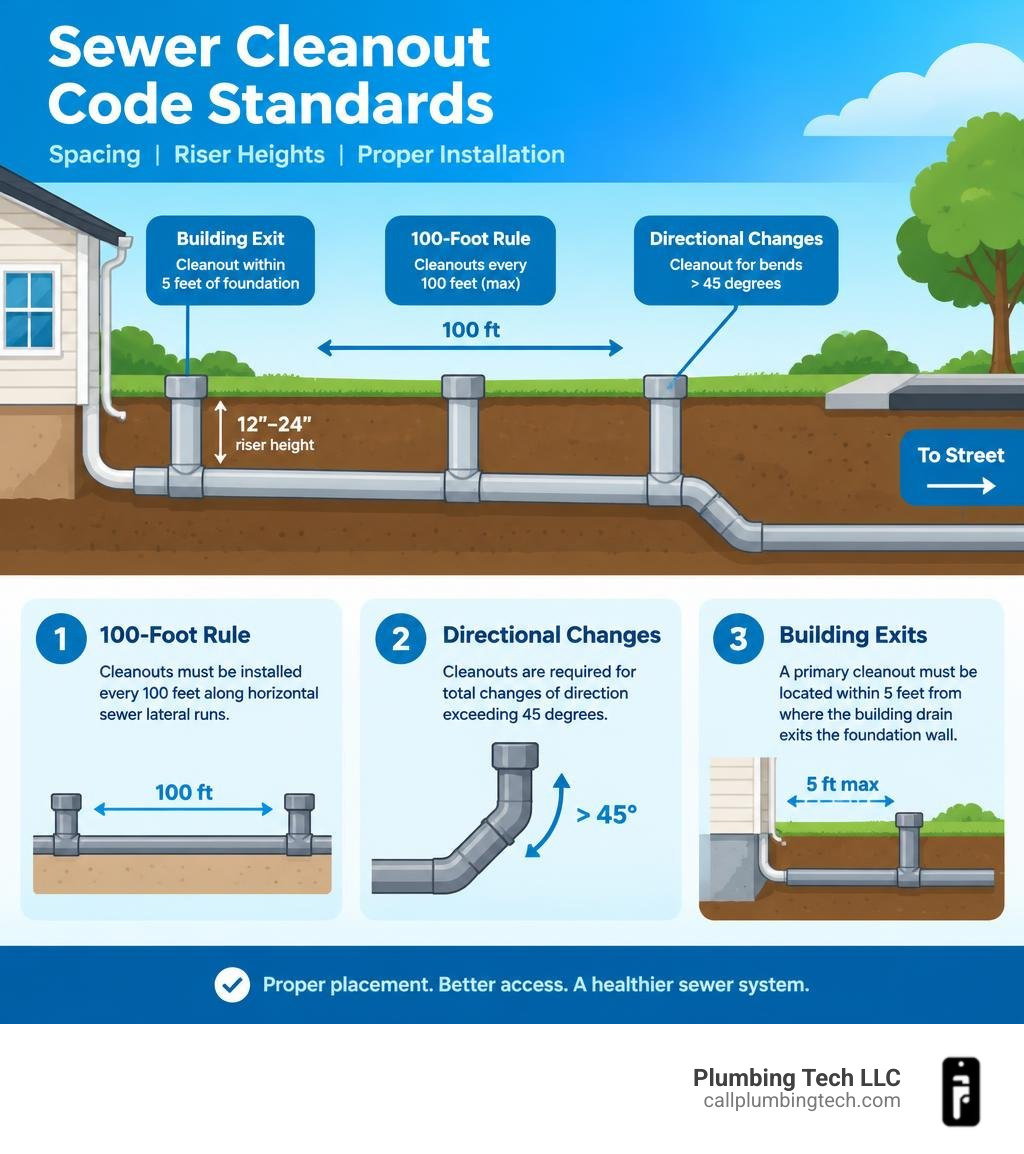
Plumbing codes, including the International Plumbing Code (IPC) and Uniform Plumbing Code (UPC), require cleanout access points at specific intervals:
- 100-Foot Rule: Cleanouts must be installed every 100 feet along horizontal sewer lateral runs.
- Directional Changes: Cleanouts are required for total changes of direction exceeding 45 degrees.
- Building Exits: A primary cleanout must be located within a set distance from where the building drain exits the foundation wall.
PVC Schedule 40 DWV Specifications and ASTM Standards
Residential and light commercial sewer lines rely primarily on rigid Polyvinyl Chloride (PVC) DWV fittings for their strength, smooth interior surface, and chemical resistance.
When installing a cleanout, fittings must meet recognized industry standards:
- ASTM D2665: The standard specification for Polyvinyl Chloride (PVC) plastic drain, waste, and vent pipe and fittings, ensuring reliable dimensions and chemical resistance.
- ASTM D1784: Specifies the compound rigid properties of the PVC material to ensure it handles ground movement and structural loads.
- NSF 14 Certification: Verifies that the plastic piping components meet sanitary requirements and structural performance baselines.
- Temperature Limitations: Standard PVC DWV components are rated for gravity systems handling fluids up to 140 degrees Fahrenheit.
Using heavy-duty Schedule 40 cleanout fittings ensures the underground hub resists root intrusion, prevents pipe shifting, and stands up to years of pressure from heavy drain cleaning cables.
Step-by-Step Installation Considerations and Service Clearances
Installing a bidirectional cleanout requires precision excavation, careful pipe alignment, and proper solvent-welding procedures.
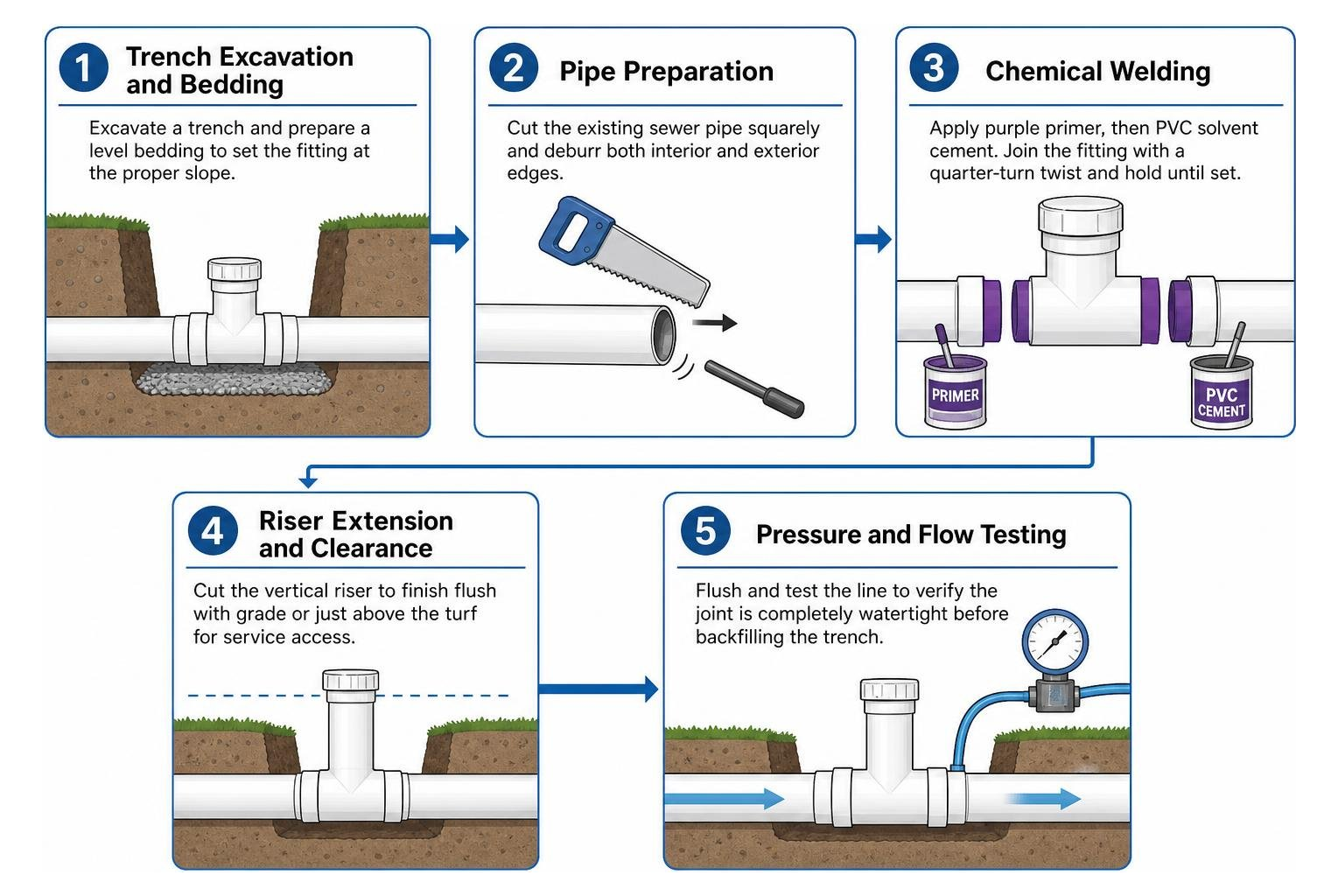
- Trench Excavation and Bedding: Technicians dig a trench to expose the lateral pipe, clearing enough space around and beneath the line to set the fitting at its proper slope without stressing the joints.
- Pipe Preparation: The existing sewer pipe is cut squarely and deburred on both interior and exterior edges to remove loose plastic fragments that could snag passing waste.
- Chemical Welding: Mating surfaces are treated with purple primer to soften the plastic, followed by a smooth coat of heavy-duty PVC solvent cement. The fitting is joined with a quarter-turn twist to distribute cement evenly, then held firmly in place while the joint cures.
- Riser Extension and Clearance: The vertical riser is cut to finish flush with the surrounding grade or just above the turf. This provides adequate working room around the fitting while keeping it safe from lawn care equipment.
- Pressure and Flow Testing: Before backfilling the trench, the line is flushed and tested to verify that the joint is completely watertight.
Frequently Asked Questions About Sewer Cleanouts
What is the primary difference between a 2-way cleanout tee and a double wye kit?
A 2-way cleanout tee is a single, compact fitting with built-in dual curved sweeps that send tools upstream or downstream through one vertical access riser. A double wye cleanout kit uses separate angled wye fittings joined together, often requiring two separate riser pipes and access caps at the surface.
While double wye assemblies provide very gentle 45-degree entry angles that reduce friction on older mechanical cables, they require a larger excavation trench and cost more to assemble. A modern single-piece 2-way tee delivers smooth access in a clean, compact profile that is much easier to fit into small yards.
Where should a bidirectional sewer cleanout be positioned on a property?
A bidirectional sewer cleanout is typically positioned outside the building footprint, roughly three to five feet away from the foundation wall where the main drain exits the home.
In some jurisdictions and property layouts, a second cleanout is installed near the property line or utility easement where the private lateral connects to the public sewer system. Placing the cleanout in an open landscape bed or near turf provides easy access for plumbers while keeping it out of primary vehicle paths.
Can installing an exterior cleanout resolve recurring sewer line clogs?
A cleanout does not dissolve clogs or repair broken pipes by itself. It is an access point rather than a repair mechanism. However, installing one allows plumbers to use heavy-duty cleaning equipment that can solve recurring issues.
With full-size access, technicians can use high-pressure water jetting to clear thick grease or 4-inch mechanical root cutters to slice away invasive tree roots. It also provides an easy entry point for regular preventative maintenance, helping you keep the line clear before waste backs up into your home.
Conclusion
A well-maintained sewer lateral is essential for a safe, sanitary, and functional home. Upgrading your plumbing system with an exterior bidirectional cleanout provides quick access for clearing blockages, simplifies video camera inspections, and keeps dirty machinery outside your living areas.
Plumbing Tech LLC delivers complete diagnostic, installation, and sewer line maintenance solutions throughout Greater Cleveland, including Strongsville and Richfield, OH. Our licensed, veteran-owned team brings over 25 years of combined trade experience to every job, using modern equipment backed by a 100% satisfaction guarantee. Whether you want to add an exterior access point to an older home or need comprehensive plumbing services to resolve recurring drainage issues, our technicians are ready to help. Contact us today to schedule your system evaluation or book your next professional sewer cleaning.