Flexible vs Rigid: What Code Requires for Your Gas Appliance Line
Flexible vs. Rigid Piping: Understanding Fuel Gas Code Requirements
Choosing the right pipe material ensures that fuel gas flows safely without leaks or pressure drops. The National Fuel Gas Code (NFPA 54) and International Fuel Gas Code (IFGC) provide clear instructions on which materials are permitted in residential and commercial buildings.
Fuel gas piping must handle continuous pressure, resist corrosion, and withstand environmental vibrations. While rigid pipe has served as the industry standard for decades, modern corrugated stainless steel tubing offers flexibility across complex routing paths. However, flexible tubing does not eliminate the need for strict compliance with structural standards and manufacturer instructions.
| Pipe / Fitting Type | Code Listing | Permitted Locations | Primary Use Case |
|---|---|---|---|
| Rigid Black Steel Pipe | ASTM A53 / ASTM A106 | Inside walls, through floors, outdoors, basements | Main distribution trunks, branch supply lines, high-impact areas |
| Corrugated Stainless Steel Tubing (CSST) | ANSI LC-1 / CSA 6.26 | Concealed inside walls, through joists, attics, crawlspaces | Flexible branch runs, retrofits where rigid pipe threading is impractical |
| Flexible Appliance Connector | ANSI Z21.24 / ANSI Z21.69 | Open room only, visible from appliance to shut-off valve | Final hookup for movable ranges, dryers, and stationary water heaters |

Rigid Black Steel Pipe vs. Corrugated Stainless Steel Tubing (CSST)
Rigid black iron pipe is thick-walled, durable, and highly resistant to mechanical punctures. Because it resists nails, screws, and external crushing forces, black iron remains the top material for exposed gas runs in basements, mechanical rooms, and industrial spaces. Installing rigid pipe requires precise measurement, cutting, threading, and heavy pipe wrenches to seal every joint properly.
Corrugated Stainless Steel Tubing (CSST) provides a lightweight alternative that can bend around structural framing without requiring separate elbow fittings at every turn. Brands like Pro-Flex CSST are tested and listed for natural gas and propane systems with maximum operating pressures up to 5 psi (34.5 kPa).
Code requires specific safeguards when using CSST:
- Electrical Bonding: CSST systems must be bonded to the electrical grounding electrode system to lower the risk of arc-induced pinholes caused by nearby lightning strikes.
- Mechanical Protection: Where CSST passes through wall studs or floor joists within puncture-risk zones, hardened steel striker plates must shield the tubing from drywall screws and nails.
- Support Spacing and Bend Radius: CSST requires proper pipe support intervals and must strictly follow the manufacturer minimum bend radius to prevent metal fatigue.
- Brand Integrity: Never intermix fittings and components from different CSST manufacturers.
When updating supply lines throughout your home, our residential plumbing services help guarantee your system adheres strictly to local Greater Cleveland safety codes.
Flexible Appliance Connectors vs. Dedicated Piping
A common mistake is confusing flexible CSST branch piping with flexible appliance connectors. Dedicated piping like CSST or black iron delivers gas from your meter to the room where your equipment lives. A flexible appliance connector serves only as the final link between the permanent pipe stub-out and the equipment inlet.
Under ANSI Z21.24 and CSA 6.10, flexible Gas Connectors are certified exclusively for exposed, indoor installations. These yellow-coated, corrugated stainless steel hoses protect against harsh household cleaning chemicals, but they are not approved for structural piping:
- Connectors are strictly single-use products. Moving an old range to install a new one requires replacing the flexible connector.
- Connectors must never run through walls, floors, ceilings, or appliance housings.
- Commercial kitchens with movable equipment on casters must use heavy-duty ANSI Z21.69 connectors equipped with integrated restraining cables to prevent physical strain on the line.
Sizing and Code Standards for a Gas Line Appliance Connection
A gas appliance will fail to operate safely if the pipe size causes an excessive drop in supply pressure. Undersized lines lead to improper fuel-to-air combustion ratios, creating excess carbon monoxide, soot, and erratic burner ignition.
Calculating BTU Demand and Pressure Drop Requirements
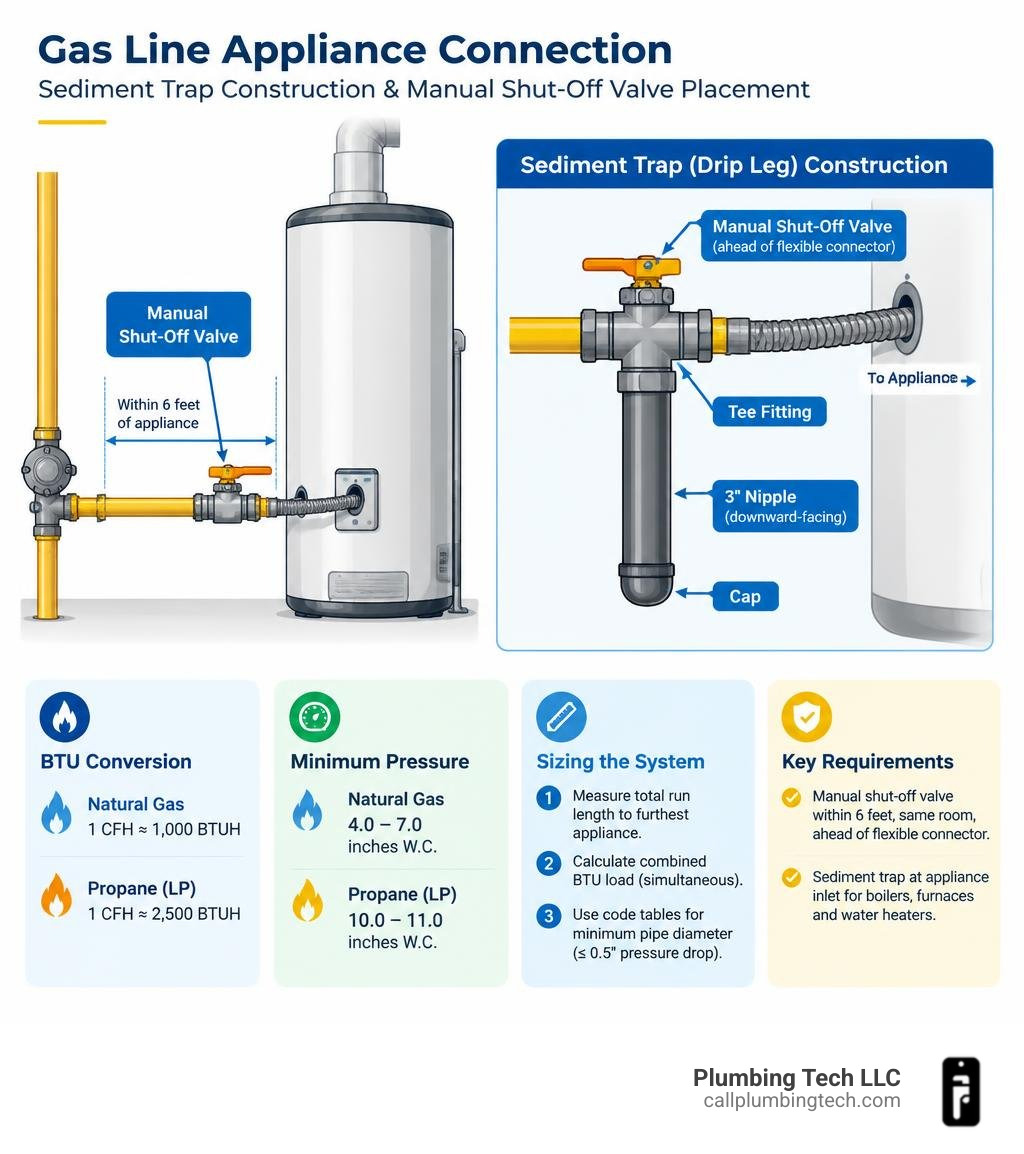
Every appliance features a manufacturer data plate displaying its maximum British Thermal Unit (BTU) hourly input rating. To size your system accurately, convert the total BTU load into Cubic Feet per Hour (CFH).
For natural gas with a specific gravity of 0.60, one cubic foot per hour (1 CFH) equals roughly 1,000 BTUH. For propane with a specific gravity of 1.52, 1 CFH equals roughly 2,500 BTUH. For example, a 60,000 BTUH natural gas range demands a supply capacity of 60 CFH.
Plumbers use the longest-run method to size gas distribution systems:
- Measure the total linear distance from the gas meter or second-stage regulator to the furthest appliance in the building.
- Calculate the total combined BTU load of all appliances that might draw gas simultaneously along that run.
- Consult code-approved sizing tables to establish the minimum pipe diameter that delivers the required CFH without exceeding a pressure drop of 0.5 inches water column.
If you are planning an extensive kitchen remodel in Cuyahoga or Summit County, our team provides expert kitchen plumbing repairs to verify that your gas lines deliver optimal pressure for high-output cooktops and ovens.
Shut-Off Valves and Sediment Trap Requirements
Fuel gas codes require dedicated safety hardware immediately upstream of every fuel-burning appliance:
- Manual Shut-Off Valve: An approved, gas-rated ball valve must sit within six feet of the appliance, located in the same room, and ahead of any flexible connector. The valve handle must remain unobstructed for quick shutoff during emergencies.
- Sediment Trap (Drip Leg): Fuel gas often carries microscopic pipe scale, condensation, and debris. Appliances such as boilers, furnaces, and storage water heaters must have a sediment trap installed directly at the equipment inlet. This trap uses a tee fitting with a capped, downward-pointing 3-inch pipe nipple. As gas changes direction through the tee, physical contaminants drop into the capped nipple instead of clogging sensitive appliance gas control valves.
Proper sediment trap and valve placement is an essential part of every compliant water heater repair & installation project.
Safe Installation Guide: Connecting Your Gas Equipment
Handling gas line connections requires patience, precision, and the correct assembly techniques. Gas leaks present serious fire and explosion hazards, meaning every fitting must be checked and sealed properly before operation. When setting up complex commercial equipment, our certified commercial plumbing services ensure every run meets code before startup.
Pre-Installation Preparation and Material Inspection
Safe hookups begin with thorough component inspection and preparation:
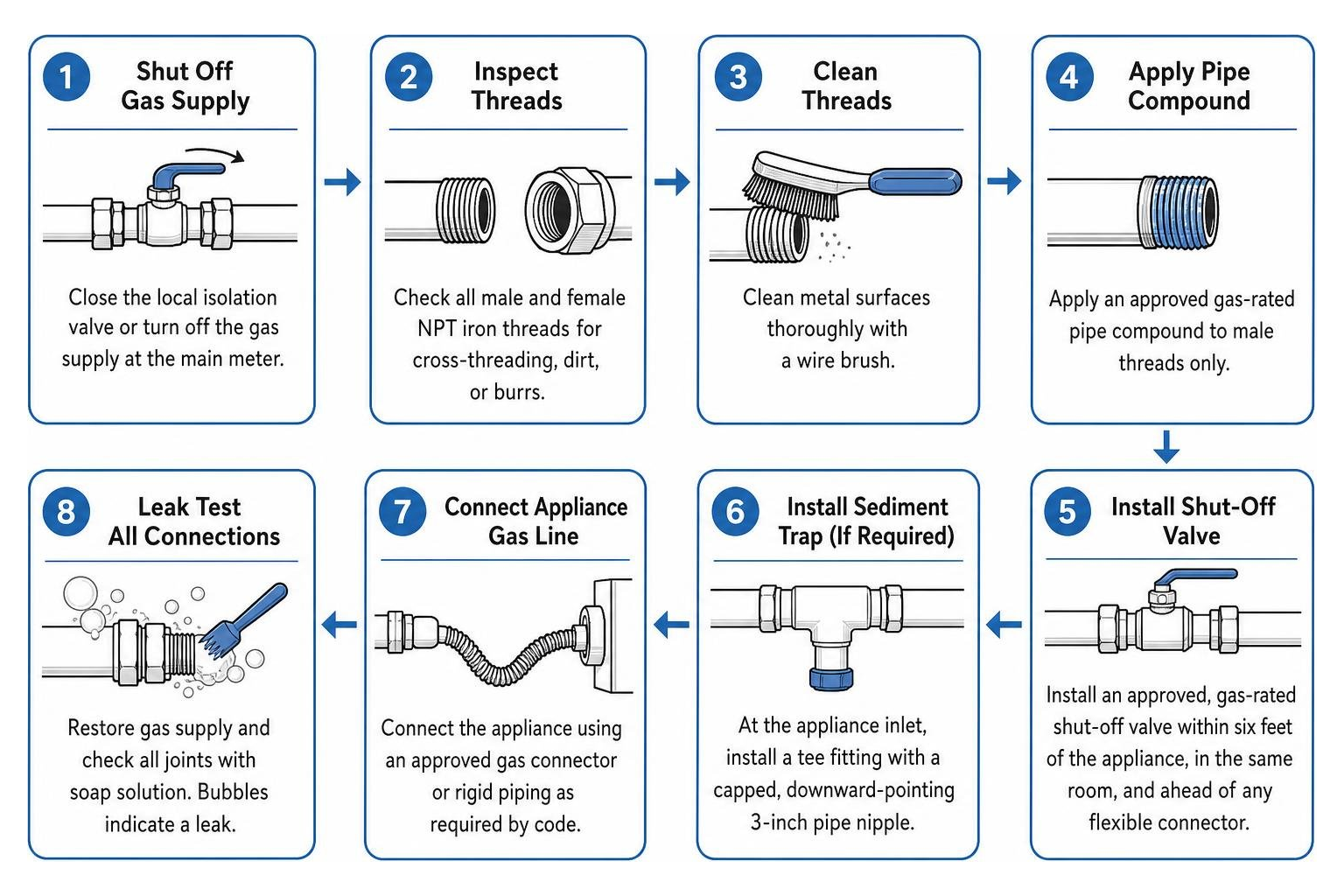
- Shut Off the Gas Supply: Close the local isolation valve or turn off the gas supply at the main meter.
- Inspect the Threads: Check all male and female National Pipe Taper (NPT) iron threads for cross-threading, dirt, or burrs. Clean metal surfaces thoroughly with a wire brush.
- Apply Sealant Correctly: Coat male NPT threads with gas-rated pipe dope or yellow PTFE tape rated for fuel gas systems. Never apply pipe dope or thread tape to flared connector fittings or flare nuts. Flared joints seal via precision metal-to-metal contact against the angled adapter seat. Adding thread sealant to flare threads prevents proper seating and causes gas leaks.
- Follow the Easy 3-Step manufacturer guide to select the right length and prevent sharp turns.
Step-by-Step Gas Line Appliance Connection Installation
- Install the Gas Shut-Off Ball Valve: Thread the gas-rated ball valve onto the incoming rigid supply pipe using pipe dope on the male threads. Tighten securely with an adjustable wrench while counter-holding the pipe with a pipe wrench.
- Mount the Appliance Adapter: Thread the male NPT end of the flare adapter into the appliance pressure regulator inlet using pipe sealant on the NPT threads only.
- Attach the Flexible Connector: Fasten the flared connector nut to the flare adapter on the appliance side. Thread the other flared connector nut onto the shut-off valve flare adapter.
- Use the Dual-Wrench Technique: Always use two wrenches when tightening flare nuts. Hold the stationary adapter with one wrench while turning the flare nut with the second wrench to achieve the recommended torque (250 to 520 in-lb for 1/2-inch connectors). This prevents twisting the connector body or stripping the appliance regulator threads.
- Observe Bend Radius and Length: Ensure the connector is 2 to 3 inches longer than the distance from the stub-out to the appliance. Avoid kinks, sharp 90-degree bends, or trapped loops behind the unit.
- Install Safety Hardware: For commercial caster-mounted equipment, secure the restraining cable to a solid wall stud to stop physical movement before the flexible hose reaches tension.
Critical Leak Testing and Pressure Verification
Never light a pilot light, ignite a burner, or flip an electrical switch until every joint passes leak testing:
- Apply Leak Detection Fluid: Brush or spray a non-corrosive, commercially approved gas leak test solution across every threaded joint, flare connection, and shut-off valve seam.
- Inspect for Bubbles: Watch each joint for several minutes. Growing bubbles, foaming, or expanding soap layers indicate gas escaping through the threads.
- Correct Any Leaks: If bubbles appear, close the manual gas shut-off valve immediately, loosen the joint, inspect the mating surfaces, re-apply approved sealant to NPT threads, and retighten.
- Wipe Clean: Rinse the soap solution off brass and stainless steel components with a damp cloth to prevent long-term surface corrosion.
- Emergency Response: If you smell the rotten-egg odor of mercaptan or suspect a hidden leak in your walls, leave the building immediately and reach out to our emergency plumbing services for rapid, safe resolution.
Frequently Asked Questions About Gas Line Appliance Hookups
Can Push-Fit Fittings Be Used for a Gas Line Appliance Connection?
No. Push-fit fittings (such as standard SharkBite products) are certified solely for potable drinking water and hydronic radiant heating systems. They are strictly prohibited on fuel gas lines by NFPA 54, the IFGC, and local plumbing regulations.
Standard push-fit fittings use elastomeric O-rings designed to seal against water pressure. Natural gas and propane dry out and degrade these rubber compounds over time, causing seal failure, hidden leaks, and severe fire hazards. Fuel gas connections demand rigid threaded black iron joints, approved CSST mechanical fittings, or listed metal-to-metal flared adapters.
Can a flexible gas appliance connector be concealed within a wall or floor?
No. Flexible appliance connectors must remain completely visible and accessible within the same room as the appliance. Running a flexible connector through drywall, subflooring, cabinetry partitions, or dropped ceilings violates fuel gas codes.
Connectors are vulnerable to punctures from drywall screws, nails, and sharp building materials. When routing gas through building cavities, install rigid black iron pipe or properly shielded and bonded CSST. Only transition to a flexible connector outside the wall surface, directly downstream of an accessible shut-off valve.
What is the maximum allowable length for a flexible gas appliance connector?
Under standard residential fuel gas codes, flexible appliance connectors for stationary equipment (such as ranges, clothes dryers, and water heaters) are limited to an overall length of 3 to 6 feet, depending on local municipal rules.
The connector should provide enough slack to slide the appliance out for servicing without straining the fittings, but must not be so long that it kinks, coils, or rests against hot venting pipes. Commercial foodservice equipment using listed ANSI Z21.69 hose assemblies may utilize approved longer runs when supported by code-compliant restraining cables.
Conclusion
A dependable gas connection requires precision, the right materials, and adherence to fuel gas codes. From calculating BTU demand to testing every fitting for leaks, skipping steps is never worth the safety risk.
At Plumbing Tech LLC, we bring over 25 years of combined trade experience as a veteran-owned local contractor. Our technicians handle residential and commercial gas work across Greater Cleveland, including Strongsville and Richfield, backed by a 100% satisfaction guarantee. Whether you are installing a high-end range or require professional gas line repair, our team delivers dependable, code-compliant craftsmanship to keep your home and business safe.