What Happens During Certified Backflow Preventer Testing?
Understanding Backflow and Hydraulic Cross-Connection Hazards
During certified backflow preventer testing, a certified tester inspects the assembly, attaches a differential pressure gauge to the test cocks, and verifies check valve tightness and relief valve operation. This process confirms that the device still prevents contaminated water from flowing backward into the clean drinking water supply.
Potable water in any community moves under positive hydraulic pressure to keep clean water flowing steadily from the water treatment plant into homes and businesses. A cross-connection is any physical link between this clean drinking water supply and a source of pollution or contamination. When unintended pressure changes happen, water can flow in reverse, turning that connection into a health hazard.
Reverse flow occurs through two primary mechanisms:
- Backsiphonage: This happens when municipal line pressure drops suddenly. Common causes include a nearby water main break, heavy firefighting activity at a street hydrant, or high neighborhood demand. The sudden pressure drop creates a vacuum effect, siphoning non-potable water backward out of irrigation lines, boiler feeds, or utility sinks directly into clean distribution pipes.
- Backpressure: This occurs when internal equipment within a building, such as a high-pressure commercial boiler, an auxiliary booster pump, or a closed-loop heating system, generates higher pressure than the incoming city water main. This excess force pushes contaminated liquids upstream into the public water network.
Without mechanical containment barriers, severe water contamination can quickly reach neighborhood faucets. To prevent these incidents, public utilities establish strict rules supported by guidance on cross-connection control programs. If an underground pipe develops a leak, it can also create pressure irregularities that require prompt water line repair to restore safe hydraulic pressure.
Common Backflow Devices and Assembly Types
Different plumbing setups require specific mechanical assemblies depending on the hazard level of the application. The most common backflow preventers include:
- Reduced Pressure Zone Assemblies (RPZ / RPBA): These provide the highest level of mechanical protection. An RPZ includes two independent, spring-loaded check valves separated by a hydraulically operated differential relief valve. If either check valve leaks, the relief valve opens to vent the contaminated water into a drain or outdoor discharge point.
- Double Check Valve Assemblies (DCVA): These contain two independently acting check valves housed within a single body. They work well for low-to-medium hazard situations where contaminants affect taste or odor rather than human health.
- Pressure Vacuum Breakers (PVB): Commonly used on outdoor residential and commercial lawn irrigation systems, a PVB uses an independently operating spring-loaded check valve and an air inlet valve to break any vacuum created by backsiphonage.
- Double Check Detector Assemblies (DCDA): Specifically designed for dedicated fire sprinkler lines, these units pair a standard double check assembly with a secondary bypass meter to detect leaks or unauthorized water usage.
| Assembly Type | Protection Level | Hazard Classification | Typical Applications |
|---|---|---|---|
| Reduced Pressure Zone (RPZ) | Backsiphonage and Backpressure | High Hazard (Toxic Chemicals, Health Risks) | Commercial boilers, medical facilities, chemical processing, high-risk irrigation |
| Double Check Valve (DCVA) | Backsiphonage and Backpressure | Low to Medium Hazard (Non-Toxic, Aesthetic Issues) | Fire suppression systems, food service beverage lines, multi-family domestic lines |
| Pressure Vacuum Breaker (PVB) | Backsiphonage Only (Continuous Pressure) | Medium Hazard (Non-Continuous Submersion) | In-ground lawn sprinkler systems, residential landscape lines |
| Atmospheric Vacuum Breaker (AVB) | Backsiphonage Only (Non-Continuous Pressure) | Low to Medium Hazard (Non-Health Concerns) | Hose bibbs, janitorial mop sinks, vegetable sprayers |
Step-by-Step Procedure for Backflow Preventer Testing
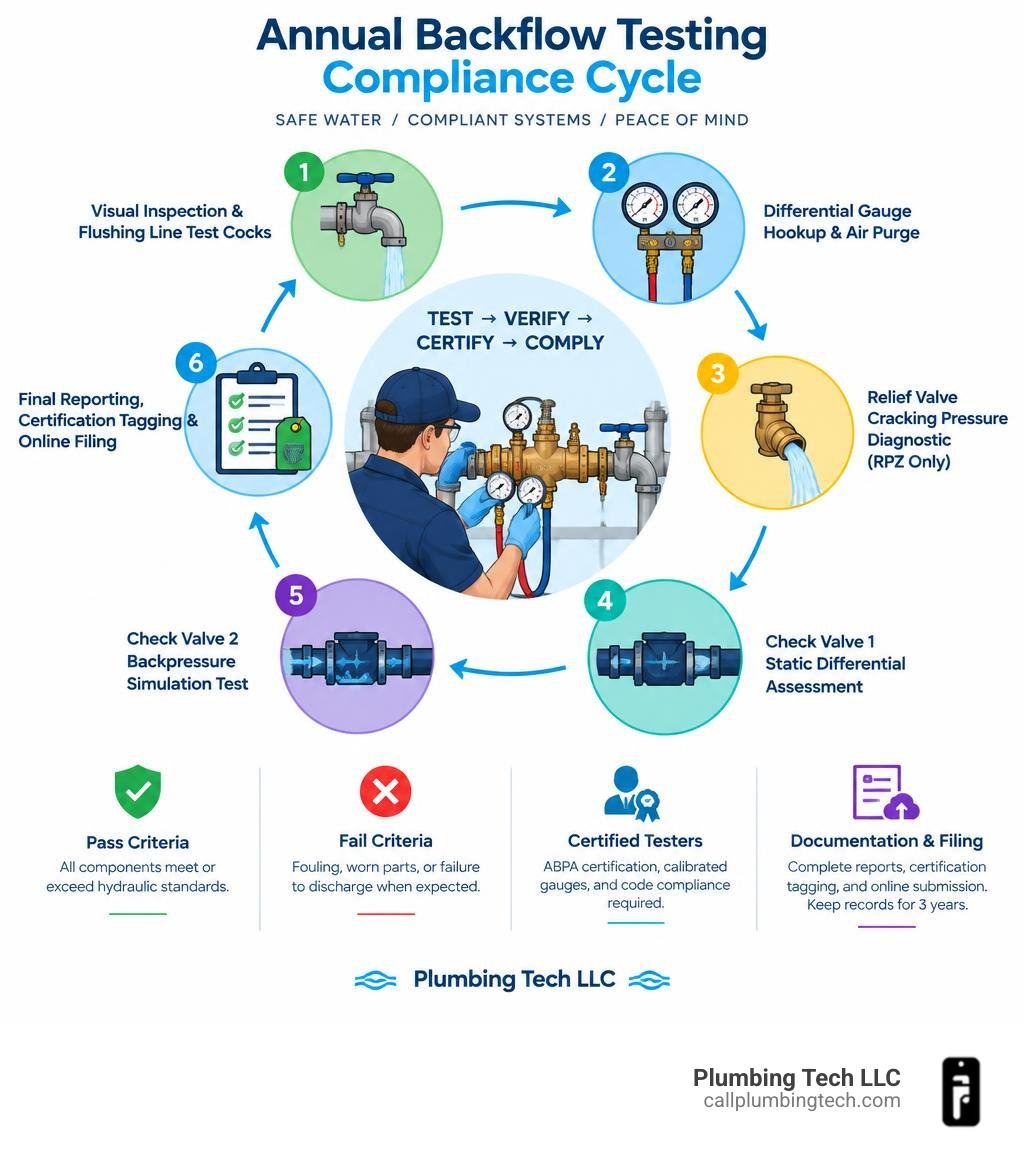
Certified testers follow standardized diagnostic steps using specialized differential pressure test gauges. These multi-valve gauge kits hook directly into the built-in test cocks on the assembly to take accurate hydraulic readings.
Step 1: Pre-Test Inspection and Line Preparation for Backflow Preventer Testing
Before opening any test ports, the technician performs a visual inspection of the installation. The specialist checks for packing leaks around shutoff handles, missing test cock caps, corrosion, physical damage, and correct clearance from walls and floors.
Next, the technician slowly bleeds line debris by opening and flushing each of the four test cocks on the assembly. Flushing eliminates accumulated sediment, pipe scale, or mineral grit that could clog the sensitive diagnostic gauge or scratch the internal rubber check discs during testing. Once the lines are clear, the tester hooks up the color-coded hoses from the calibrated test kit.
Step 2: Testing the Relief Valve Differential Pressure
For high-hazard RPZ devices, the relief valve must be tested first. The technician attaches the high-pressure hose to test cock 2 and the low-pressure hose to test cock 3, then closes isolation shutoff valve number 2 to stop downstream water flow.
By opening the needle valves on the test gauge, the tester lowers the pressure in the intermediate chamber between the two check valves. The specialist watches the gauge needle closely to record the exact cracking pressure at which the relief valve opens and discharges water. To pass, the relief valve must open before the pressure differential between the supply line and the zone drops below a strict 2.0 psi minimum.
Step 3: Checking Valve Tightness and Directional Flow
Next, the technician verifies the tight closure of the internal check valves:
- Check Valve 1: The tester measures the static differential pressure across the first check valve to ensure it holds tight against incoming supply pressure with a minimum reading of 5.0 psi on an RPZ assembly.
- Check Valve 2: The technician creates an artificial backpressure condition downstream using the test kit bypass hose to verify that the second check valve seals completely. If water leaks backward through the seat, the pressure reading drops, indicating a failed check valve.
Pass and Fail Criteria for Field Tests
A backflow preventer passes the field evaluation only when every internal component meets or exceeds hydraulic standards:
- RPZ Relief Valve: Must discharge water freely when the differential drops to or above 2.0 psi.
- First Check Valve: Must remain fully closed and hold a steady pressure differential without leaking.
- Second Check Valve: Must hold tight against simulated backpressure without allowing any reverse flow.
- Shutoff Valves: Both inlet and outlet isolation valves must seal completely with zero drop in line pressure when closed.
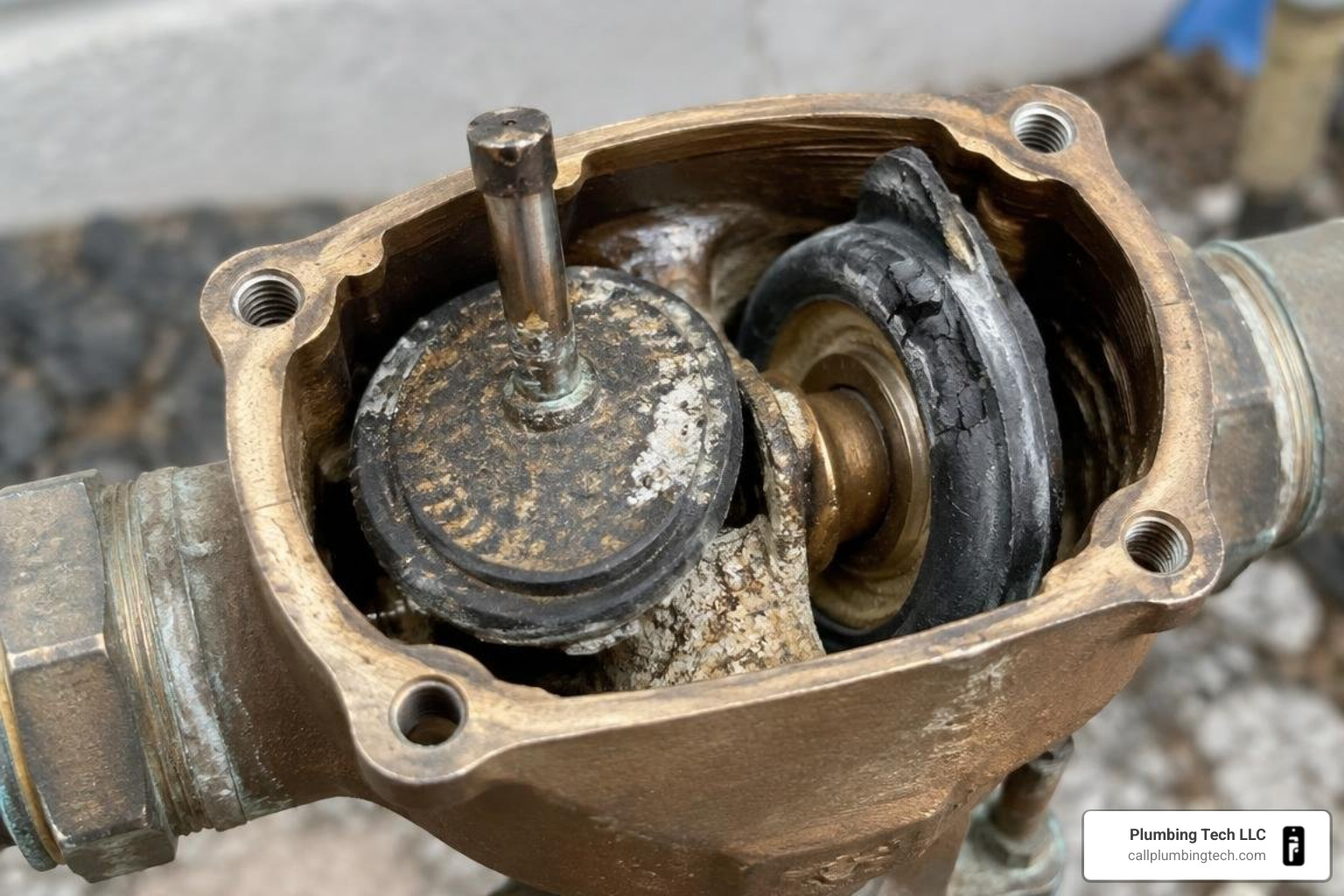
A device fails if internal fouling from sand or scale prevents a disc from seating, if rubber components have hardened, cracked, or deformed, or if a relief valve fails to discharge when expected.
Certified Tester Qualifications and Regulatory Compliance
Because backflow prevention directly protects drinking water safety, testing cannot be performed by an uncertified handyman. Testers must hold professional certifications validating their technical ability to diagnose complex assemblies in accordance with ABPA tester certification standards.
Certified testers must use differential pressure gauges that undergo annual laboratory recalibration to ensure measurement accuracy. In addition, commercial facilities must follow local plumbing codes and commercial plumbing requirements to keep their containment assemblies in compliance.
Documentation, Reporting, and Municipal Submission
After completing the diagnostic run, the certified tester must record all raw pressure readings, gauge serial numbers, calibration dates, and component conditions on official state or municipal compliance forms, such as TCEQ Form 20700 test reports or local water authority inspection sheets.
Passed assemblies receive an official, weather-resistant certification tag affixed directly to the valve body showing the date of inspection, tester certification number, and company credentials. The tester submits the official report to the local water department through approved municipal web portals within required reporting deadlines. Both property owners and testing companies must retain physical or digital copies of all test records for at least three years.
What Happens When a Backflow Assembly Fails?
If an assembly fails any portion of its diagnostic test, it no longer protects the potable water system. Municipal regulations require the tester to notify the property owner and report the failed result to the water purveyor.
Failing to address a broken backflow preventer can lead to formal violation notices, municipal fines that accumulate daily, and eventual shutoff of water service to prevent contamination of the city water main.
Troubleshooting and Repairing Assembly Components
When an assembly fails, a skilled technician can often rebuild the internal parts without replacing the entire bronze valve body. Common repairs include:
- Replacing worn rubber discs, diaphragms, and O-rings.
- Cleaning mineral scale, rust deposits, and debris from internal brass valve seats.
- Replacing fatigued stainless steel springs to restore proper seating tension.
- Flushing out the differential relief valve sensing lines.
For properties that cannot afford extended downtime, having access to fast emergency plumbing repairs ensures the assembly gets rebuilt, retested, and certified quickly to keep water flowing safely.
Maintenance Schedules and Requirements for Backflow Preventer Testing
Plumbing codes require routine testing schedules based on the device type and application hazard level:
- Reduced Pressure Zone (RPZ) Assemblies: Tested at initial installation, after any repair or relocation, and at least semi-annually or annually as mandated by local ordinances.
- Double Check Valve Assemblies (DCVA): Tested at least once every 12 months.
- Pressure Vacuum Breakers (PVB): Tested annually, usually during springtime irrigation startup.
Property owners should also schedule routine residential plumbing inspections to evaluate shutoff valves and protect above-ground outdoor assemblies from freezing during winter months.
Frequently Asked Questions About Backflow Testing
How long does a certified backflow test take?
A standard backflow test takes roughly 20 to 30 minutes per device, assuming the shutoff valves hold tight and the test cocks are easily accessible. If internal repairs, cleaning, or seat replacements are needed, the process can take an additional hour or two.
How much does backflow testing and rebuilding cost?
Testing costs vary based on assembly size, location, device type, and municipal filing fees. Rebuilding an existing unit by replacing the internal rubber parts and springs is generally far more economical than purchasing and installing a brand-new valve assembly.
Why must water service be temporarily shut off during testing?
Testing requires isolating the backflow assembly from building water demand using its integrated shutoff valves. Shutting off the downstream flow stops active water movement, allowing the differential pressure gauge to measure static holding pressure and check for internal leaks accurately.
Conclusion
Protecting your drinking water from contamination is an essential safety responsibility for homeowners and business managers alike. Regular testing keeps your property compliant with water district regulations and gives you peace of mind that your water remains safe to drink.
At Plumbing Tech LLC, our veteran-owned team brings over 25 years of combined experience to every job across Greater Cleveland, including Strongsville and Richfield, OH. Our certified backflow specialists use modern diagnostic equipment and back all work with a 100% satisfaction guarantee. Contact us today to schedule your annual inspection with our trusted certified plumbing services.